Trigeminal Nerve Stimulation (TNS) in Faridabad
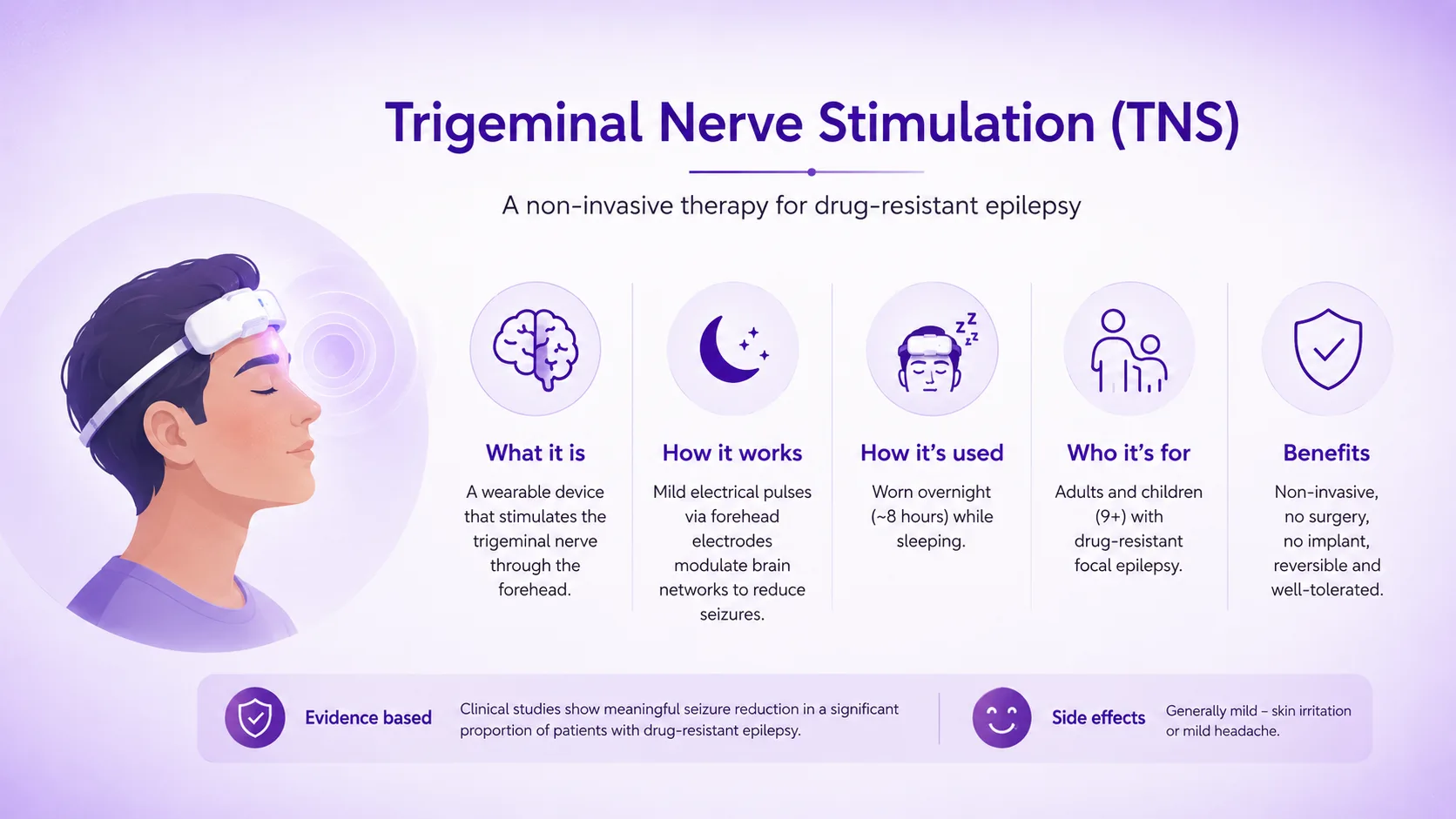
For patients living with drug-resistant epilepsy – where two or more appropriate anti-seizure medications have failed to control seizures – the search for a safe, effective alternative is urgent. Trigeminal Nerve Stimulation (TNS) is a non-invasive neuromodulation therapy that delivers mild electrical stimulation through the skin of the forehead to modulate seizure-generating networks in the brain. It requires no surgery, no implant, and no anaesthesia.
Key Facts About TNS for Epilepsy
- What it is: A non-invasive, wearable device that stimulates the trigeminal nerve through forehead electrodes to reduce seizure frequency
- Who it is for: Adults and children (typically aged 9+) with drug-resistant focal epilepsy who have not responded to at least two medications
- How it works: Worn overnight (~8 hours); no surgery, no implant required
- Evidence: CE-marked in Europe for drug-resistant epilepsy; clinical studies show meaningful seizure reduction in a significant proportion of patients
- Side effects: Generally mild – skin irritation, mild headache; no serious device-related adverse events reported in long-term studies
- Available in Faridabad: Yes – evaluated and coordinated by Dr Satyakam Baruah at Amrita Hospital, Sector 88, Faridabad
Early Diagnosis Saves Lives - Book an Appointment Today with Dr Satyakam Baruah!
What is Trigeminal Nerve Stimulation (TNS)?
Trigeminal Nerve Stimulation (TNS), also called external trigeminal nerve stimulation (eTNS), is a non-invasive neuromodulation therapy for epilepsy. It works by delivering low-level electrical pulses to the supraorbital and supratrochlear branches of the trigeminal nerve – the fifth cranial nerve – through small adhesive electrodes placed on the forehead.
The device most studied in clinical trials is the Monarch eTNS system, developed by NeuroSigma. It received CE certification in Europe in 2012 for the adjunctive treatment of drug-resistant epilepsy in patients aged 9 and older, and has also received Health Canada approval for the same indication.
TNS is not a cure. It is an adjunctive therapy – used alongside existing anti-seizure medications to reduce seizure frequency when medications alone are insufficient.
It is also emphatically not a treatment for trigeminal neuralgia (facial pain). The trigeminal nerve is simply the access point; the therapeutic target is the brain’s seizure network.
How Does TNS Work for Epilepsy?
The trigeminal nerve has extensive projections into the brainstem and beyond. When TNS delivers electrical pulses to its superficial branches, those signals travel centrally and activate key brainstem nuclei – particularly the nucleus tractus solitarius (NTS) and the locus coeruleus.
This matters for epilepsy for several reasons:
- Noradrenergic modulation: Activation of the locus coeruleus increases noradrenaline release, which has well-established anticonvulsant effects – the same mechanism implicated in vagus nerve stimulation (VNS).
- Brainstem network modulation: Trigeminal afferents connect broadly with cortical and limbic circuits, enabling “bottom-up” modulation of seizure-generating networks without targeting any single brain region.
- Seizure threshold elevation: Animal studies suggest TNS reduces synchronised neuronal firing and raises the threshold at which seizures are triggered.
The mechanism is not yet fully characterised, but the clinical evidence is consistent with meaningful seizure reduction in a subset of patients with drug-resistant focal epilepsy. A 2025 systematic review in Frontiers in Neurology identified seven eligible studies encompassing 148 patients, with all studies reporting seizure frequency reductions from baseline.
Crucially, because the stimulation is external and non-invasive, the brain itself is never directly accessed.
Who is a Candidate for TNS Therapy?
TNS is not appropriate for every epilepsy patient. A careful evaluation is essential before recommending it. Dr Satyakam Baruah assesses each patient individually against the following criteria.
You may be a suitable candidate if:
- You have been diagnosed with drug-resistant epilepsy – defined as failure of two or more appropriately chosen and tolerated anti-seizure medications
- Your epilepsy is focal in onset (temporal lobe or frontal lobe epilepsy; temporal lobe epilepsy has shown particularly favourable responses in clinical studies)
- You are not a candidate for resective surgery, or surgery has been considered and declined
- You are aged 9 or older (the age range studied in clinical trials)
- You are willing to use the device consistently, typically overnight for approximately 8 hours per night
- You are not pregnant (TNS has not been studied in pregnancy)
TNS is generally not recommended if:
- You have a cardiac pacemaker or other implanted electrical device (device interaction must be assessed)
- You have active skin conditions or wounds on the forehead at the electrode sites
- Your epilepsy has a clearly identified surgical focus that is amenable to curative resection – in that case, surgery remains the preferred option
The evaluation at Amrita Hospital includes a detailed seizure history, review of prior medications, neuroimaging, and in many cases video-EEG monitoring to characterise the epilepsy type before any neuromodulation pathway is recommended.
The TNS Procedure: What to Expect
Before the Procedure
TNS does not involve a procedure in the surgical sense. However, the preparation phase is thorough.
- Comprehensive epilepsy evaluation: Dr Baruah reviews your seizure history, MRI brain, EEG findings, and medication history to confirm drug resistance and assess candidacy.
- Baseline seizure diary: You will be asked to keep a detailed seizure diary for 4–8 weeks before starting TNS to establish a reliable baseline seizure frequency.
- Device fitting and education: Once TNS is recommended, you and your family are trained on correct electrode placement, device settings, and what to expect during the initial weeks of therapy.
- Medication review: Your existing anti-seizure medications are reviewed and optimised where possible. TNS is always used as an add-on to medication, never as a replacement.
During the Procedure
There is no procedure room, no anaesthesia, and no incision. TNS is used at home.
- Electrode placement: Small adhesive electrode patches are applied to the forehead, over the supraorbital region, each evening before sleep.
- Stimulation session: The device delivers a gentle electrical current – typically at 120 Hz – for approximately 8 hours overnight. Most patients describe the sensation as a mild tingling or vibration. It should never be painful.
- Nightly routine: The device is switched on at bedtime and removed in the morning. It fits easily into a normal sleep routine.
- Ongoing monitoring: Regular follow-up appointments with Dr Baruah’s team track seizure frequency, medication tolerance, and any side effects.
After the Procedure
Because TNS is non-invasive, there is no recovery period.
- Response timeline: Clinical studies report that meaningful seizure reduction typically becomes apparent after 8 to 12 weeks of consistent nightly use. Some patients see improvement earlier; others require longer.
- Follow-up schedule: Dr Baruah’s team schedules reviews at 4 weeks, 12 weeks, and 6 months to assess response and adjust the plan if needed.
- Seizure diary continuation: Keeping an accurate diary throughout treatment is essential for objectively measuring response.
- Long-term use: For patients who respond, TNS is continued long-term. The device is non-invasive and has shown good tolerability over 12 months in prospective studies with no serious device-related adverse events.
Benefits of Trigeminal Nerve Stimulation
TNS offers a distinct set of advantages compared to implanted neuromodulation devices and resective surgery. These are not marketing claims – they are the practical realities that make TNS a meaningful option for the right patient.
- Non-invasive: No surgery, no implant, no anaesthesia. The entire therapy is external.
- Reversible: If TNS does not work, or if a patient wishes to stop, the therapy is simply discontinued. Nothing has been permanently altered.
- No surgical risk: There is no risk of infection, bleeding, or neurological injury from the device itself.
- Home-based: Treatment happens during sleep. There is no need for hospital admissions or clinic visits for the therapy itself.
- Mood benefits: Multiple clinical studies have reported improvements in depression and quality of life alongside seizure reduction – a meaningful secondary benefit for a population that carries a high burden of psychiatric comorbidity.
- Compatible with other treatments: TNS can be used while other neuromodulation options are being evaluated, and does not preclude future surgical options.
- Paediatric-friendly: Approved for use in children aged 9 and older; the non-invasive nature makes it particularly acceptable for families reluctant to consider implanted devices.
TNS vs Other Neuromodulation Therapies
TNS is one of several neuromodulation options available for drug-resistant epilepsy. The right choice depends on seizure type, epilepsy syndrome, surgical candidacy, and patient preference. The table below provides a concise comparison.
| Feature | TNS (eTNS) | VNS (Vagus Nerve Stimulation) | DBS (Deep Brain Stimulation) | RNS (Responsive Neurostimulation) |
| Invasiveness | Non-invasive (external) | Minimally invasive (implanted) | Invasive (brain implant) | Invasive (brain implant) |
| Surgery required | No | Yes (neck incision) | Yes (craniotomy) | Yes (craniotomy) |
| Reversible | Yes (fully) | Partially | Partially | Partially |
| Mechanism | Trigeminal afferents → brainstem → cortex | Vagal afferents → NTS → cortex | Thalamic network modulation | Closed-loop cortical stimulation |
| Target epilepsy type | Focal drug-resistant | Focal and generalised | Focal (thalamic circuits) | Focal (known seizure focus) |
| Typical responder rate | ~40–50% (≥50% seizure reduction) | ~50–55% at 2 years | ~50–60% at 2 years | ~50–60% at 2 years |
| Key advantage | No surgery; home-based; reversible | Long clinical track record | Effective for specific syndromes | Personalised closed-loop response |
| Key limitation | Evidence base still growing | Requires surgical implant | Most invasive option | Requires precise focus localisation |
| Paediatric use | Yes (age 9+) | Yes | Selected cases | Selected cases |
Dr Baruah’s approach is to match the neuromodulation strategy to the individual patient – not to recommend a single device for everyone. For some patients, TNS is the right first step. For others, VNS, DBS, or RNS will be more appropriate. This decision is made after a thorough evaluation.
Struggling with Seizures, Persistent Headaches, or Other Neurological Symptoms?
Risks and Side Effects of TNS
TNS has a well-documented safety profile. Long-term prospective studies have reported no serious device-related adverse events over 12 months of use. That said, patients should be aware of the following:
Common and mild:
- Skin irritation or redness at the electrode site – the most frequently reported side effect; usually resolves with electrode repositioning or a brief break from use
- Mild headache during or after stimulation sessions, typically in the first few weeks
- Sleep disturbance in a small number of patients who find the stimulation sensation distracting initially
Less common:
- Tingling or mild discomfort at the forehead – expected and generally well-tolerated; stimulation intensity can be adjusted
- Anxiety or restlessness reported by a small number of patients in early studies
What has not been reported:
- No serious neurological adverse events
- No cardiac effects
- No cognitive deterioration
- No device-related infections (as there is no implant)
It is important to note that TNS does not eliminate seizures in all patients. Approximately 40–50% of patients in clinical studies achieve a 50% or greater reduction in seizure frequency – a meaningful improvement, but not a guarantee. Patients who do not respond after 12 weeks of consistent use are reassessed and alternative neuromodulation pathways are considered.
TNS for Children with Epilepsy
Drug-resistant epilepsy in children carries a particularly heavy burden – on the child’s development, on school attendance, and on the entire family. When medications have failed and surgery is not appropriate, families are often searching for a safe, non-invasive option.
TNS is approved in Europe for children aged 9 and older with drug-resistant epilepsy. Its non-invasive nature makes it particularly well-suited to the paediatric population:
- No anaesthesia required – a significant advantage for children and parents
- No surgical risk – no risk of infection, bleeding, or neurological injury
- Home-based treatment – the child sleeps with the device; school attendance and daily routine are unaffected
- Reversible – if the child does not respond, or if a better option becomes available, TNS is simply stopped
Clinical studies and audits have reported good tolerability in children, with the most common side effect being mild forehead skin irritation that resolves with electrode adjustment.
Dr Satyakam Baruah’s evaluation for paediatric TNS includes a detailed developmental history, review of seizure semiology, EEG characterisation, and a family counselling session to ensure realistic expectations and consistent device use at home.
Why Choose Dr Satyakam Baruah for TNS in Faridabad?
Choosing the right specialist for TNS therapy in Faridabad – or for any neuromodulation pathway – matters enormously. The therapy itself is only as good as the evaluation that precedes it.
Dr Satyakam Baruah’s credentials and approach:
- MCh Neurosurgery from NIMHANS, Bengaluru – one of India’s premier neuroscience institutions
- Subspecialty fellowship at the Montreal Neurological Institute, McGill University, Canada – a globally recognised centre for functional neurosurgery and epilepsy
- Member of the MNI Robotic Stereo-EEG Team (2018–2019) – with direct experience in advanced epilepsy mapping techniques
- 20+ years of experience in neurosurgery, with 5,000+ procedures performed and 2,000+ epilepsy patients treated
- Active memberships in NSI, WSSFN (World Society for Stereotactic and Functional Neurosurgery), AANS, and Advisory Board Member of E.A.S.E., Hyderabad
What sets the approach apart:
- Neuromodulation for epilepsy is not a single decision – it is a pathway. Dr Baruah evaluates each patient to determine whether TNS, VNS, DBS, RNS, or resective surgery is the most appropriate next step, rather than defaulting to one option.
- Imaging-first protocol: Every patient undergoes dedicated neuroimaging and EEG characterisation before any neuromodulation recommendation is made.
- Multidisciplinary review: Complex drug-resistant epilepsy cases are reviewed with neurologists, neuroradiologists, and neuropsychologists before a treatment plan is finalised.
- Transparent communication: Realistic response rates, timelines, and alternatives are discussed at every consultation. There are no guarantees – only evidence-based decisions.
Amrita Hospital, Faridabad – where Dr Baruah practices – is a premier tertiary care centre with state-of-the-art neuro-imaging, specialised neuro-ICUs, advanced EEG and video-EEG monitoring, and internationally aligned standards of care. It is NABH and NABL accredited.
Book Your Consultation
If you or a family member has drug-resistant epilepsy and seizures are not adequately controlled on current medications, a specialist evaluation is the right next step. Trigeminal Nerve Stimulation in Faridabad is one of several advanced neuromodulation options available through Dr Satyakam Baruah’s practice – and the right option is determined by a thorough, individualised assessment, not a default recommendation.
To book a consultation with Dr Satyakam Baruah at Amrita Hospital, Faridabad:
- 📞 Phone: +91-9650708834
- 💬 WhatsApp: Available via the same number
- 📧 Email: contact.satyakambaruah@gmail.com
- 📍 Address: Amrita Hospital, Mata Amritanandamayi Marg, RPS City, Sector 88, Faridabad, Haryana 121014
Bring any prior MRI reports, EEG recordings, and a list of medications tried to your first appointment. The more information available, the more precise the evaluation
Frequently Asked Questions
Is TNS the same as treatment for trigeminal neuralgia (facial pain)? expand_more
No - and this distinction is critical. Trigeminal neuralgia is a facial pain condition caused by nerve compression. Trigeminal Nerve Stimulation (TNS) for epilepsy uses the trigeminal nerve as an access pathway to modulate the brain's seizure networks. The nerve is the route, not the target. The two conditions and their treatments are entirely unrelated.
Who qualifies for TNS therapy in Faridabad? expand_more
TNS is considered for patients with drug-resistant focal epilepsy - meaning seizures have continued despite at least two appropriately chosen anti-seizure medications. Candidates are typically aged 9 or older, not pregnant, and without implanted electrical devices that may interact with the stimulator. A full evaluation by Dr Baruah is required to confirm suitability.
How long does TNS take to work? expand_more
Most patients who respond to TNS begin to see a meaningful reduction in seizure frequency after 8 to 12 weeks of consistent nightly use. Some respond earlier; others require up to 6 months. Patients who show no response after 12 weeks of proper use are reassessed and alternative options are discussed.
Is TNS reversible? expand_more
Yes - completely. Because TNS is non-invasive and external, stopping the therapy simply means removing the device. Nothing is implanted, nothing is permanently altered. This reversibility is one of TNS's most significant advantages over implanted neuromodulation devices.
What does TNS cost, and is it available in Faridabad? expand_more
TNS evaluation and coordination is available through Dr Satyakam Baruah's practice at Amrita Hospital, Faridabad. The cost of the device and ongoing therapy varies depending on the patient's specific programme. Please contact the clinic directly for current pricing and availability. Dr Baruah's team will also advise on whether TNS or another neuromodulation approach is the most cost-effective pathway for your situation.
Can TNS be used alongside other epilepsy treatments? expand_more
Yes. TNS is always used as an adjunctive therapy - it is added to existing anti-seizure medications, not used as a replacement. It can also be used while other neuromodulation options are being evaluated, and does not preclude future surgical interventions if they become appropriate.

Dr. Satyakam Baruah’s Medical Content Team
Dr. Satyakam Baruah’s medical content team specialises in creating accurate, clear, and patient-focused healthcare content. With strong clinical understanding and expertise in technical writing and SEO, the team translates complex medical information into reliable, accessible resources that support informed decisions and uphold Dr. Satyakam's commitment to quality care.
This content is reviewed by Dr. Satyakam Baruah
Related Treatments

Stereotactic Brain Biopsy in Faridabad
A stereotactic brain biopsy is a minimally invasive procedure that uses 3D imaging to guide a thin needle into a…
Neurotrauma Treatment in Faridabad
A traumatic brain or spinal cord injury changes everything within seconds, and for families standing in an emergency corridor, the…
Neuronavigation Surgery in Faridabad
The fear most patients carry into brain surgery is not about the tumor. It is about what the surgeon might…

Neuroendoscopy Surgery in Faridabad
When something goes wrong inside the brain, like a build-up of fluid, a cyst, or a blocked passage, the idea…
Brain Tumor Surgery in Faridabad
Brain tumor surgery in Faridabad under Dr. Satyakam Baruah includes the diagnosis, surgical treatment, and long-term management of both benign…
Thalamotomy & Pallidotomy Procedures in Faridabad
Thalamotomy and Pallidotomy in Faridabad are among the most advanced functional neurosurgical procedures available for patients suffering from debilitating movement disorders.…
Related Blogs
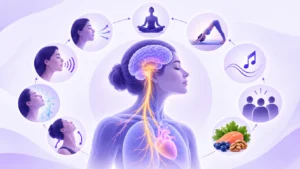
Vagus Nerve Stimulation Exercises and At-Home Techniques
Vagus nerve stimulation exercises – including slow diaphragmatic breathing, humming, cold water exposure, yoga, and…
Read Article →
Beyond Seizures: What Life Looks Like After Successful Epilepsy Surgery
Epilepsy surgery achieves seizure freedom in 60–70% of carefully selected patients with drug-resistant epilepsy. Recovery…
Read Article →
Recovery After Spine Surgery: Complete Patient Guide
Spine surgery recovery progresses from hospital discharge and gentle walking in weeks one to two,…
Read Article →
Epilepsy Support Groups in India: Finding Community and Help
Epilepsy support groups in India connect patients and caregivers with peer support, practical advice, and…
Read Article →
Diet for Epilepsy Patients: Foods to Eat and Avoid
Epilepsy patients benefit from magnesium-rich, omega-3, and antioxidant foods while avoiding refined sugar, alcohol, and…
Read Article →
Is Epilepsy Hereditary?
In Summary – What You Need to Know Epilepsy is not always hereditary. About 30–40% of cases have…
Read Article → WhatsApp