
Recovery After Spine Surgery: Complete Patient Guide

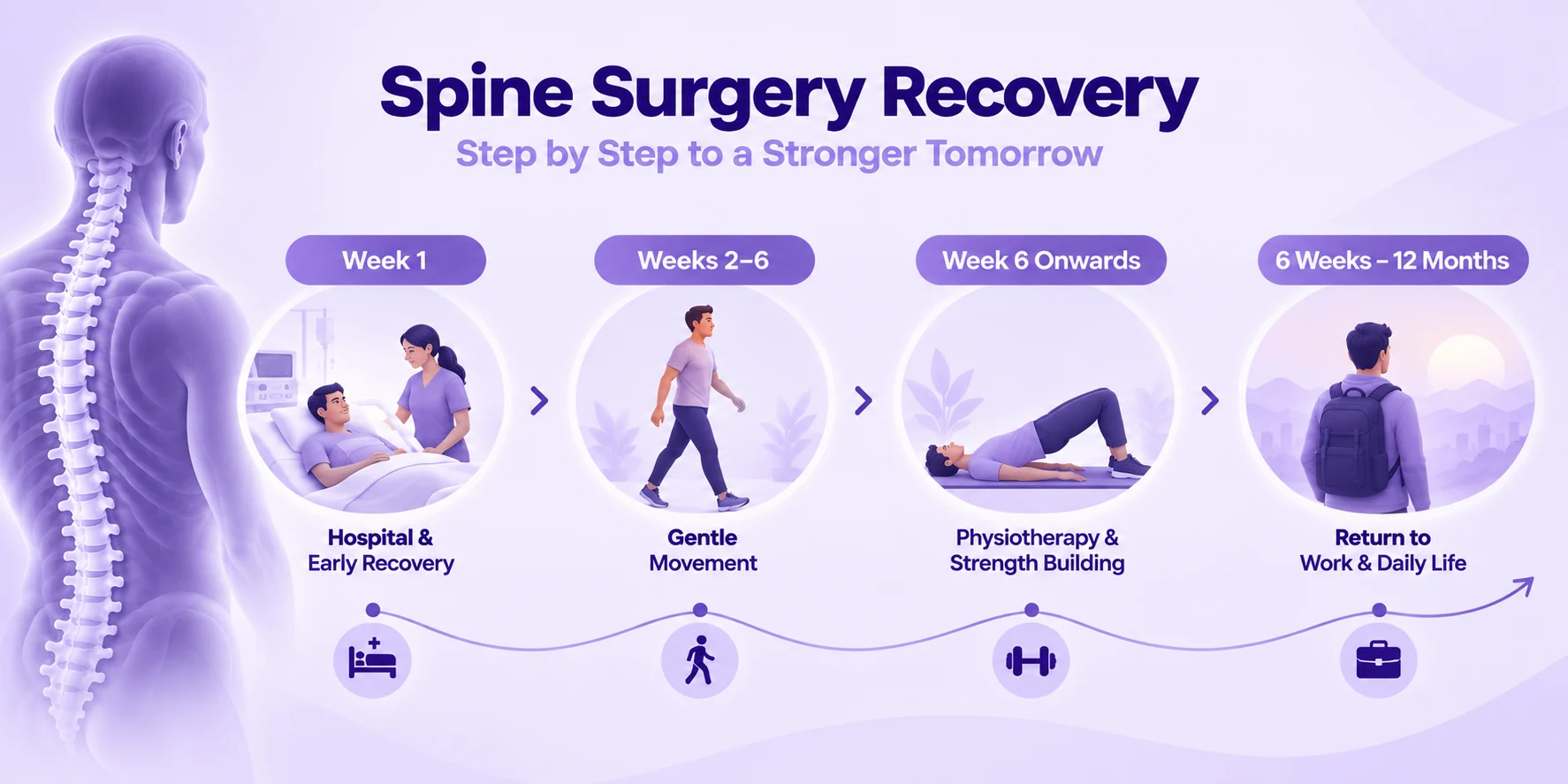
Spine surgery recovery progresses from hospital discharge and gentle walking in weeks one to two, through physiotherapy-guided core strengthening from week six, to full return to work and activity between six weeks and twelve months – depending on procedure type and complexity.
Early Diagnosis Saves Lives - Book an Appointment Today with Dr Satyakam Baruah!
What to Expect in the First Week After Spine Surgery
The first week sets the tone for everything that follows. Most patients are surprised by how much is asked of them – and how quickly.
- Hospital stay: Most spine surgeries require a stay of 2–5 days. Minimally invasive procedures often allow discharge on day 2 or 3; open spinal fusion may need 4–5 days of monitoring.
- Pain management: Some pain is expected and is managed with a combination of oral analgesics, anti-inflammatories, and in some cases a short course of nerve pain medication. Do not wait for pain to become severe before asking for relief – staying ahead of it helps you move sooner.
- Wound care: The incision site is typically closed with sutures or surgical staples and covered with a sterile dressing. Keep it dry, avoid soaking in water, and watch for any signs of infection. Your nurse will show you how to clean and redress it before discharge.
- First steps with a physiotherapist: In most hospitals, a physiotherapist will see you within 24–48 hours of surgery. This is not optional – early guided movement reduces clot risk, prevents muscle stiffness, and begins the process of retraining your spine. Expect to sit up, stand, and take short assisted walks within the first two days.
- No bending, twisting, or lifting: These three movements – collectively called BLT restrictions – are off-limits for the first 4–6 weeks in most cases, and longer after fusion. This is non-negotiable. Violating BLT restrictions is one of the most common causes of setbacks in the early recovery period.
The First Month: Building Your Foundation
The first month post-spine surgery focuses on gentle mobilisation, correct posture, no driving, and essential follow-up appointments for safe recovery.
1. Gradual Mobilisation – take short walks of 10–15 minutes, two to three times daily, slowly increasing distance as comfort improves.
2. Posture – maintain a neutral spine when sitting, standing, and lying down; use a firm chair with lumbar support rather than a soft sofa.
3. No Driving – avoid driving for the first 4–6 weeks due to physical demands and the effect of pain medication on reaction time.
4. Follow-up Appointments – attend the 2-week wound review and 4–6 week imaging check; these are essential, not optional.
5. Foundation, Not Speed – the first month is about building a stable base for recovery, not rushing towards milestones.
Spine Surgery Recovery Exercises: What’s Safe and When
Exercise is one of the most powerful tools in your recovery – but timing and guidance matter. Starting too early or doing the wrong movements can undo surgical work. Here is a phased approach based on current evidence.
- Weeks 1–2 (in hospital and at home): Gentle ankle pumps – flexing and pointing the feet repeatedly – improve circulation and reduce deep vein thrombosis risk. Diaphragmatic breathing exercises help expand the lungs after anaesthesia and reduce the risk of chest complications. These are safe from day one.
- Weeks 3–6: A structured walking programme is the centrepiece of this phase. Begin with 10-minute walks and work toward 30 minutes daily by week 6. Gentle hamstring stretches and knee-to-chest stretches (as cleared by your physiotherapist) can begin around week 3–4 for most decompression procedures. Avoid any stretch that causes pain radiating into the legs.
- Week 6 onwards: Physiotherapy-guided core strengthening begins here for most patients. This includes exercises such as pelvic tilts, bridging, and supported abdominal work. After spinal fusion recovery, core work may be deferred to week 8–12 depending on fusion levels and imaging confirmation. Spine surgery recovery exercises should always be progressed under professional supervision – self-directed gym work before clearance is a common and avoidable mistake.
What to Eat During Spine Surgery Recovery
Nutrition is not a secondary concern – it directly affects how fast your tissues heal and how well your bones fuse. A few targeted dietary changes in the recovery period make a measurable difference.
- High protein for tissue repair: Aim for 1.2–1.5 g of protein per kg of body weight daily. Good Indian sources include dal, paneer, eggs, chicken, fish, and soya. Protein is the raw material for wound healing and muscle rebuilding.
- Calcium and vitamin D for bone healing: Spinal fusion recovery in particular depends on new bone formation. Dairy, ragi (finger millet), sesame seeds, and fortified foods provide calcium. Vitamin D – often deficient in Indian patients who spend limited time outdoors – is best supplemented at doses your doctor recommends, typically 1,000–2,000 IU daily.
- Hydration: Aim for 2–3 litres of water daily unless your doctor advises otherwise. Dehydration slows healing, thickens the blood, and increases constipation risk.
- Fibre to prevent constipation: Opioid pain medications – commonly used in the first 1–2 weeks after surgery – cause constipation in the majority of patients. A high-fibre diet (whole grains, fruits, vegetables, psyllium husk) combined with adequate hydration prevents this. Straining at stool puts direct pressure on the spine and should be avoided at all costs.
- Foods to limit: Processed foods high in refined sugar and trans fats promote systemic inflammation and slow healing. Alcohol interferes with bone healing and interacts dangerously with pain medications. Avoid both during the active recovery period.
Recovery Timelines by Procedure Type
Spine surgery recovery varies by procedure, ranging from 6–12 weeks for decompressions to 9–12 months for complex spinal fusions.
1. Discectomy & Laminectomy – fastest recovery; functionally independent at 6–8 weeks, with full recovery by 10–12 weeks.
2. Spinal Fusion – hardware stabilises immediately, but bone fusion takes 3–6 months; multilevel fusions may need up to 9–12 months for full recovery.
3. Minimally Invasive Surgery – recovery is 2–4 weeks faster than open surgery across all procedure types, due to smaller incisions and less muscle disruption.
4. Cervical Spine Surgery – collar worn for 2–6 weeks; hand dexterity and grip strength may take several months to recover if cord compression was present.
5. Spinal Fixation (rods & screws) – follows the fusion timeline, with bone healing as the key rate-limiting factor in recovery.
Red Flags: When to Call Your Surgeon Immediately
Most discomfort in the weeks after spine surgery is expected and manageable. But certain symptoms require urgent attention – do not wait for your next scheduled appointment if you notice any of the following.
- Fever above 38.5°C: A rising temperature after the first 48 hours can indicate a wound infection or, more seriously, a spinal infection (discitis or epidural abscess). This needs same-day assessment.
- Wound discharge or increasing redness: Some clear fluid from the wound in the first 24 hours is normal. Persistent discharge, pus, or spreading redness around the incision is not – contact your surgical team immediately.
- Sudden worsening of pain: A new, sharp increase in back or leg pain – especially if different in character from your usual post-operative pain – can signal implant displacement, haematoma, or nerve compression.
- New numbness or weakness in the legs: If you notice fresh numbness, tingling, or weakness in your legs or feet that was not present before, this is a neurological warning sign requiring urgent evaluation.
- Loss of bladder or bowel control: This is a neurosurgical emergency. Inability to pass urine, urinary incontinence, or loss of bowel control after spine surgery may indicate cauda equina syndrome and requires immediate hospital attendance – not a phone call, not a next-day appointment.
Struggling with Seizures, Persistent Headaches, or Other Neurological Symptoms?
Returning to Work and Daily Life
Post-spine surgery recovery involves staged return to work, driving, travel, and activity, with emotional support equally prioritised throughout healing.
1. Return to work depends on job type – desk jobs at 4–6 weeks; manual/physical labour at 3–6 months with physiotherapy clearance.
2. Driving resumes at 4–6 weeks (lumbar) or 6–8 weeks (cervical), once off strong medication and able to emergency stop confidently.
3. Travel – short flights are fine from 6 weeks; long-haul should wait until 3 months, with compression stockings and regular movement.
4. Physical activity & daily life – sexual activity can resume at 4–6 weeks, guided by comfort and individual recovery pace.
5. Emotional wellbeing – frustration and low mood mid-recovery are normal; stay connected with your physiotherapist and flag persistent low mood to your doctor.
A Note on Expert Guidance
Spine surgery is a high-stakes intervention, and the quality of post-operative guidance matters as much as the operation itself. If you are navigating recovery after a complex spinal procedure – or trying to understand whether surgery is the right step – specialist neurosurgical input is available.
Dr. Satyakam Baruah is a consultant neurosurgeon with an MCh in Neurosurgery from NIMHANS, Bengaluru – one of India’s most respected neuroscience institutions – and a fellowship from the Montreal Neurological Institute, McGill University, Canada. With over 20 years of clinical experience and more than 5,000 neurosurgical procedures performed, Dr. Baruah brings both technical depth and genuine patient-centred care to every consultation. He practices at Amrita Hospital, Faridabad. Whether you are preparing for surgery, mid-recovery and uncertain about your progress, or managing a complication, expert guidance is available – and seeking it early consistently leads to better outcomes.

 WhatsApp