Neurosurgeons’ Day 2026: Understanding Precision, Care, and Patient-Centred Neurosurgery
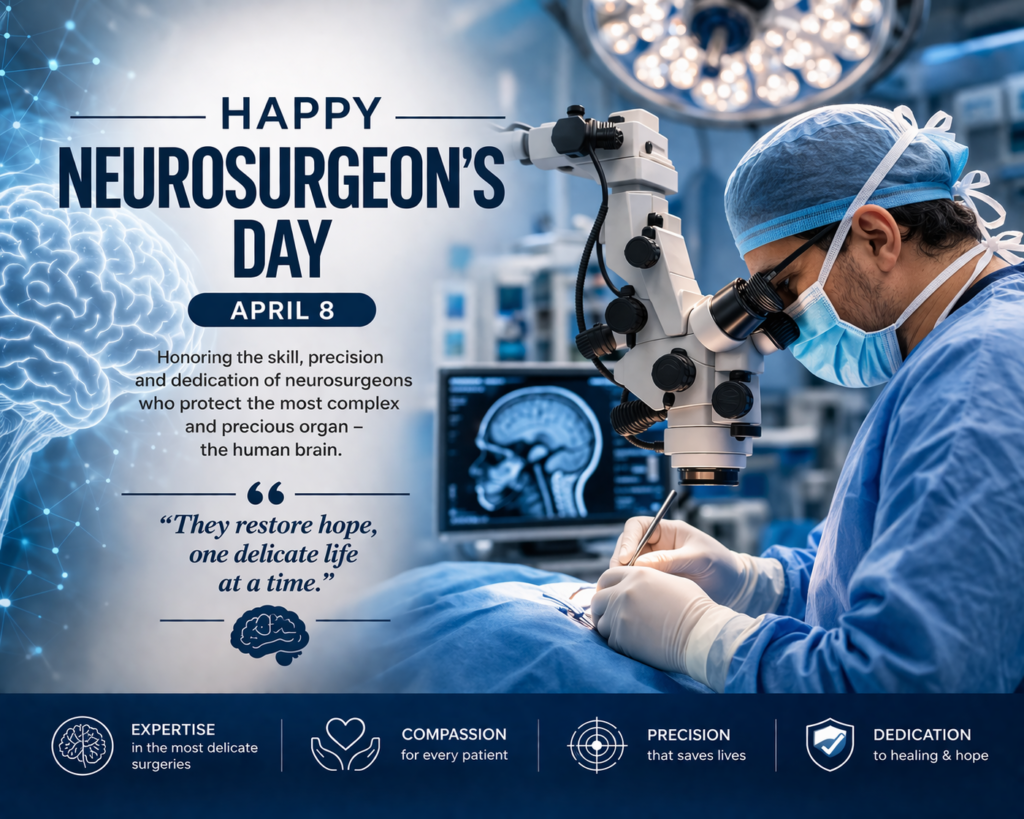
Every year on 8th April, Neurosurgeons’ Day gives patients, families, and the wider public a chance to understand what this speciality actually involves. Not the dramatic version seen on television, but the real version, years of careful training, disciplined decision-making, and a genuine commitment to helping people through some of the most difficult health situations they will face. For anyone who has been referred to a neurosurgeon or who is managing a condition that involves the brain or spine, this day is worth celebrating.
The path to becoming a neurosurgeon is one of the longest in medicine. It begins with a full medical degree, followed by years of specialised training focused entirely on the brain, spine, and nervous system. During this period, doctors gradually move from supervised learning to independent decision-making, building not just technical knowledge but also the clinical judgment that takes years of real patient experience to develop. By the time a neurosurgeon is practising independently, they typically carry more than a decade of medical education and hands-on training. That foundation is what patients rely on, and it shows in how a well-trained neurosurgeon approaches even a routine consultation with thoroughness and care.
What makes neurosurgery genuinely demanding is the precision it requires at every stage, not just in the operating room. The brain and spine control movement, speech, memory, and sensation. These are not functions that recover easily if something goes wrong, which is why every case receives a detailed evaluation before any treatment decision is made. Advanced imaging, such as MRI and CT scans, maps out the area of concern. Neurological assessments establish a clear picture of how the patient is currently functioning. Surgical planning determines not just what will be done, but the exact approach, the instruments involved, and the specific risks for that individual. This preparation is where much of the real work happens. The operation itself is the visible part of a process that is far larger and more careful than most patients realise.
When a patient first meets a neurosurgeon, they are often anxious, sometimes after weeks of unexplained symptoms or a diagnosis that raised more questions than answers. This is precisely why communication matters as much as clinical expertise. Good neurosurgical care means explaining the diagnosis in terms the patient can follow, walking through treatment options with their respective benefits and risks, and giving a realistic sense of what recovery will actually look like. Patients who understand what is happening and why make better decisions about their care. They also tend to recover better because they are not managing confusion and fear in addition to managing their condition. That kind of clear, patient-centred conversation is not secondary to treatment. It is part of the treatment.
Epilepsy is one of the clearest examples of how neurosurgical care works in practice. Most people with epilepsy manage their seizures well with medication. Roughly half respond to the first medication tried, and a further portion respond to a second drug or a combination. However, around 30 per cent of people with epilepsy continue to have seizures despite trying multiple medications. This is known as drug-resistant epilepsy, and it is where neurosurgical evaluation can genuinely change someone’s life. For these patients, the team works to identify exactly where in the brain seizures are originating, using detailed mapping and, in some cases, extended monitoring over several days. Depending on what that evaluation finds, treatment options can include surgical removal of the affected area where it is safe to do so, vagus nerve stimulation, which uses a small implanted device to send gentle signals to the brain via the vagus nerve, or deep brain stimulation, where electrodes placed in the brain help reduce seizure activity over time. The goal in every case is practical and personal, fewer seizures, more freedom, and a meaningfully better quality of life.
Beyond any individual procedure, neurosurgery is a team effort that extends across the full arc of a patient’s care. Before surgery, the treating team, which includes neurologists, anaesthetists, and condition-specific specialists, works together to develop the right treatment plan. After surgery, rehabilitation specialists, physiotherapists, and nursing staff take on a central role. Recovery from neurosurgical procedures varies widely depending on the condition and the procedure involved, but in most cases, the quality of post-operative support shapes long-term outcomes just as significantly as what happens in the operating room. Regular monitoring, follow-up consultations, and clear guidance on rehabilitation are not added extras. They are integral to the quality of neurosurgical care delivered.
The field itself continues to advance in ways that genuinely benefit patients. Improvements in imaging over the past two decades have enabled neurosurgeons to identify structures and abnormalities with greater clarity than previously possible. Intraoperative imaging, performed during surgery, allows surgeons to verify their work in real time. Minimally invasive surgical techniques have reduced recovery times for many procedures. Robotic assistance has improved precision in certain spinal surgeries. Each of these developments is evaluated carefully before being adopted into routine practice. The standard is always whether the evidence supports using a new approach for a particular patient’s situation, and neurosurgeons who stay current with research bring that informed judgment to every consultation.
For patients and families, Neurosurgeons’ Day on 8th April offers something genuinely useful a better understanding of what thoughtful, experienced neurosurgical care actually looks like. The care a patient receives is built on years of training, careful pre-operative planning, a coordinated team, and a commitment to follow-up that continues long after treatment ends. It is care that is structured, evidence-based, and centred on the individual. Knowing this makes it easier to ask the right questions, engage meaningfully with a treatment plan, and approach recovery with confidence rather than uncertainty. Neurosurgeons do not just treat conditions that affect the brain and spine. They help patients navigate situations that can feel overwhelming, and they do it with a level of preparation and responsibility that this day rightly acknowledges.

 WhatsApp