When Cancer and Epilepsy Intersect – What You Need to Know
Two conditions that seem unrelated often share a deeper biological connection. Understanding it could make all the difference in your care.
For most people, a cancer diagnosis and a seizure disorder feel like separate battles, two distinct storms arriving from different directions. But for a growing number of patients, these conditions are not separate at all. They are bound together by shared biology, overlapping treatments, and a simple truth: managing one often means managing the other.
The good news is that this connection is now well understood. And with the right approach, it opens the door to treatments that can address both conditions at once, delivering outcomes neither pathway could achieve alone.
“A seizure is not just a symptom. In some patients, it is the earliest signal that a brain tumour is present, often years before any other sign appears.”
Early Diagnosis Saves Lives - Book an Appointment Today with Dr Satyakam Baruah!
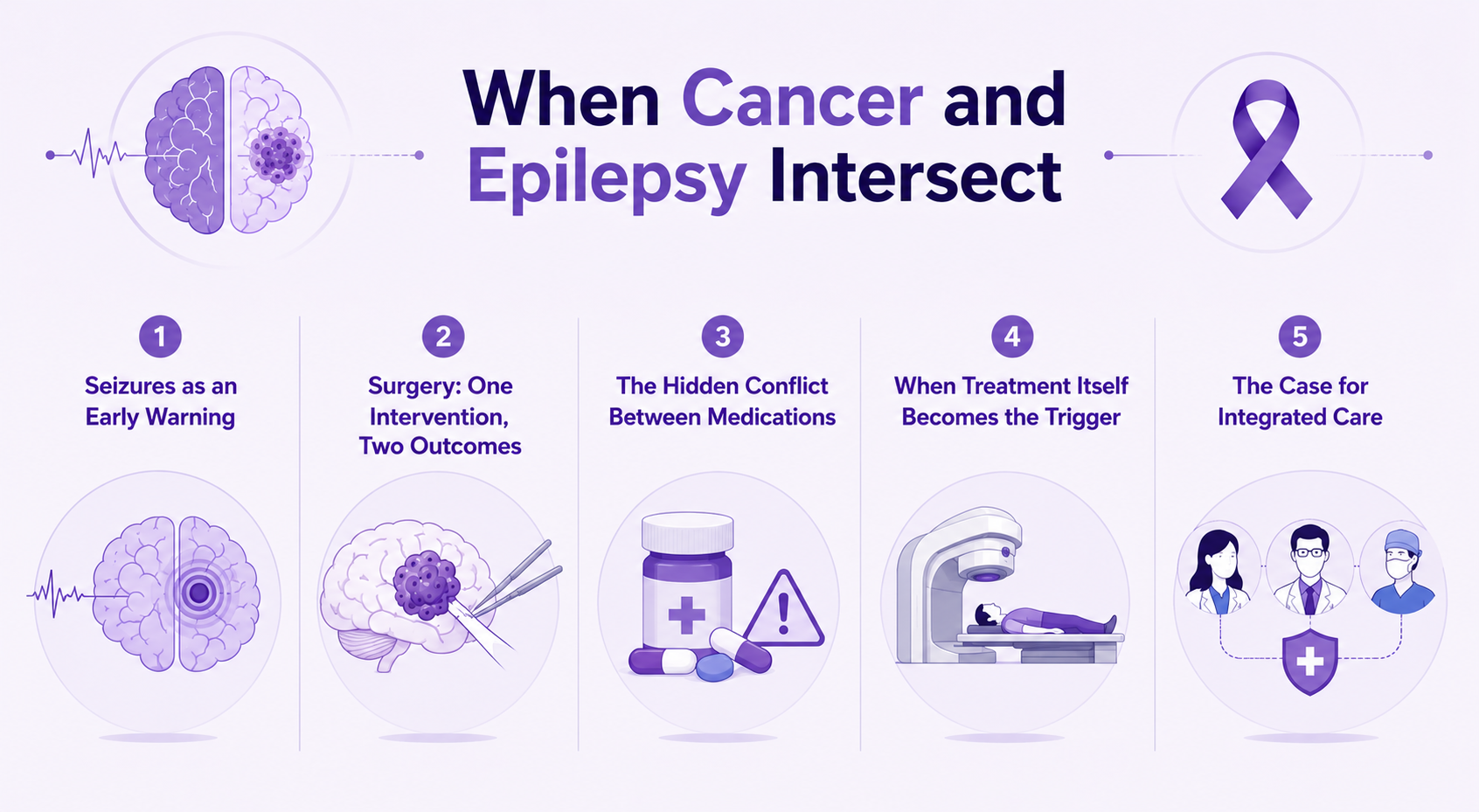
Seizures as an early warning
When a first seizure occurs in adulthood, particularly one that begins in a specific, consistent way, it warrants more than routine follow-up. Low-grade brain tumours, such as gliomas, gangliogliomas, and DNETs, can irritate surrounding neurons for years before any other symptom emerges. In these tumour types, seizures are often the only announcement the brain makes.
This does not mean every seizure hides a tumour, the vast majority do not. But a first seizure in an adult, especially a focal or stereotyped one, always deserves a thorough structural evaluation of the brain before any diagnosis is finalised. That single scan can shift the conversation from symptom management to addressing the root cause entirely.
Key figures:
- 60–80% of low-grade glioma patients experience seizures
- 30–60% of all primary brain tumour patients have seizures
- A high-quality MRI can change the entire course of care
Surgery: one intervention, two outcomes
When a tumour is identified as the driver of seizures, the treatment picture changes completely. Medication shifts from a long-term solution to a bridge. The real target is the tumour itself.
What makes this especially encouraging is that surgical removal of the tumour, when planned carefully alongside the epilepsy can achieve seizure freedom in 60 to 80% of cases. Years of medication that could not fully control seizures can sometimes be replaced by a single, well-executed operation. The two problems share one solution.
What makes surgery successful in these cases is precision: Stereo-EEG to map exactly where seizures originate relative to the tumour, advanced neuronavigation to protect healthy tissue, functional mapping to preserve language and movement, and a clear understanding of whether the tumour zone and seizure zone overlap or sit apart.
The hidden conflict between medications
When cancer and seizures coexist, patients are often managing two separate treatment regimens simultaneously. What is not always made explicit is that these regimens can interfere with each other in clinically significant ways.
Several older anti-seizure medications including phenytoin, carbamazepine, and phenobarbital activate liver enzymes that metabolise many chemotherapy agents. The result: chemotherapy is broken down faster than intended, its concentration drops, and its effectiveness is reduced. The patient takes the full dose. The outcome falls short. And the cause goes unexamined.
Newer medications such as levetiracetam and lacosamide carry no such interaction risk. Choosing the right anti-seizure medication is therefore not a minor administrative detail it is a decision with direct consequences for cancer treatment outcomes. This is precisely why both conditions need to be considered together from the start.
When treatment itself becomes the trigger
As cancer survival rates improve, more patients are living long enough to experience the neurological effects of their treatment. Radiation therapy to the brain is effective and life-saving but it can cause lasting changes in brain tissue that, in some patients, lower the threshold for seizures months or even years after treatment ends.
A person who has moved past their cancer diagnosis, who is in routine follow-up with no seizure history, can develop epilepsy as a late consequence of radiation. This is a recognised and increasingly visible phenomenon. It deserves the same careful specialist evaluation as any other new-onset seizure, a full assessment, specialist review, and a treatment plan that accounts for the full history.
The case for integrated care
Cancer and epilepsy are typically managed in separate clinics, by separate specialists, with separate goals. That division made sense when the two conditions were understood as unrelated. The evidence now points in a different direction.
A tumour can cause seizures. Seizures can be the first sign of a tumour. Cancer treatment can trigger epilepsy. Epilepsy treatment can compromise cancer therapy. These are not theoretical possibilities, they are clinical realities affecting patients today.
Integrated onco-epilepsy teams combining neurologists, neuro-oncologists, and surgeons are increasingly available at specialist centres. When seizures and a cancer diagnosis coexist, or when seizures appear in someone with a history of brain radiation, seeking this kind of comprehensive evaluation is not just helpful. It is the difference between treating symptoms and solving the problem.

 WhatsApp