World Parkinson’s Day: Bridge the Care Gap
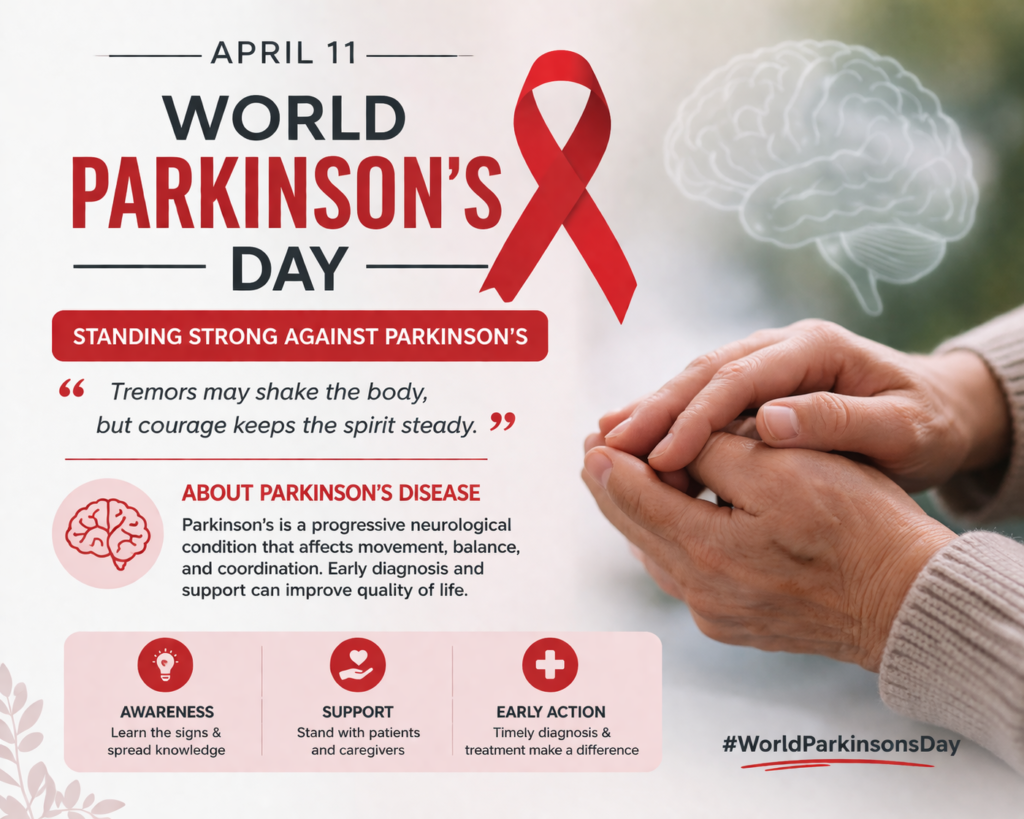
World Parkinson’s Day is observed every year on 11th April, and it carries a message that goes beyond general awareness. It is an invitation to understand what Parkinson’s disease actually involves, how it is recognized early, and what thoughtful, consistent care looks like over time. For patients and families, that understanding is not just reassuring. It is genuinely useful because Parkinson’s is a condition that responds well to timely action, the right treatment, and a team of people who know how to manage it carefully.
Parkinson’s disease is a progressive neurological condition that affects movement. It develops when brain cells responsible for producing dopamine, the chemical that enables smooth, coordinated movement, begin to decrease in number. As dopamine levels fall, the effects become noticeable in different ways for different people. Some experience a tremor, often starting in one hand at rest. Others notice muscle stiffness, slowed movement, or changes in their gait. There are also symptoms that are less obviously connected to movement: disrupted sleep, shifts in mood, a softening of the voice, or reduced facial expression. Because the condition presents differently from person to person and early symptoms can be subtle, it is not always recognized straight away.
The early signs of Parkinson’s are easy to attribute to something else. Slightly smaller handwriting, one arm that does not swing as naturally while walking, stiffness that does not ease with stretching: these changes are often assumed to be part of normal aging. Recognizing them for what they are and seeking a proper evaluation makes a real difference to how the condition is managed. Early diagnosis gives doctors more to work with. It allows treatment to begin sooner, when the benefits tend to be greater, and it gives patients and families time to plan, ask questions, and understand what to expect. Seeing a neurologist promptly, rather than waiting until symptoms become more pronounced, is one of the most positive steps a person can take.
Medication is the foundation of Parkinson’s treatment, and for many people, it works very well over a long period. The most established treatment involves medicines that restore or replicate the effect of dopamine in the brain, reducing tremors, easing stiffness, and supporting smoother movement. With the right combination and regular adjustments at follow-up appointments, a significant number of people with Parkinson’s continue to lead active, independent lives for many years. The condition does progress, and the treatment plan may need to evolve alongside it, but consistent medical care and regular monitoring help keep that progression well-managed.
For some patients, over time, medications become less consistent in their effect. Symptoms may return before the next dose is due, a phenomenon known as wearing off, or involuntary movements called dyskinesias may develop as a side effect of long-term use. When this happens, advanced treatment options can offer substantial improvement. Deep Brain Stimulation, widely known as DBS, is one of the most established of these. The procedure involves placing thin electrodes in specific brain regions that regulate movement, connected to a small device implanted under the skin of the chest. This device delivers carefully calibrated electrical signals that help normalize the abnormal brain activity driving symptoms. For carefully selected patients, DBS can significantly reduce tremors and stiffness, smooth out the unpredictable on-off fluctuations that make daily life difficult, and in many cases reduce the amount of medication needed. It does not stop the progression of Parkinson’s, but it can restore a level of control and consistency that improves daily life in meaningful ways. The decision to consider DBS follows a detailed evaluation of the patient’s symptom history, medication response, general health, and personal goals and circumstances. It is never a rushed recommendation.
Parkinson’s care extends well beyond medication and procedures. Rehabilitation is central to how patients maintain function and independence over time. Physiotherapy works on strength, balance, and walking patterns. Occupational therapy helps patients adapt daily tasks and their home environment to their changing needs. Speech therapy addresses communication and swallowing, both of which can be affected as the condition progresses. These disciplines work alongside the neurological team rather than in isolation, and coordination between them matters. Recovery and long-term management of Parkinson’s is not a solo effort by any one specialist. It is a shared team undertaking that adjusts its approach as the patient’s needs change.
Expert care plays a defining role in how effectively Parkinson’s disease is managed over time, and this is where specialists like Dr. Satyakam Baruah’s experience of 20 years becomes particularly valuable. With a focused practice in neurology and advanced neurosurgical interventions, Dr. Satyakam brings a balanced approach that combines precise diagnosis, thoughtful medical management, and when required, expertise in procedures such as Deep Brain Stimulation (DBS). Dr.Baruah’s approach is centred on careful patient selection, detailed evaluation, and long-term follow-up, ensuring that every treatment decision aligns with the patient’s symptoms, stage of disease, and quality-of-life goals. For patients navigating Parkinson’s, access to this level of structured, experienced care adds both clarity and confidence to what can otherwise feel like an uncertain journey.
The social and emotional dimensions of living with Parkinson’s deserve the same attention as the clinical ones. Changes in movement or facial expression can sometimes be misread by people unfamiliar with the condition, and that misunderstanding can lead to unnecessary isolation. Awareness among families, colleagues, and communities helps create an environment where patients feel seen and supported rather than defined by their symptoms. Caregivers also benefit from clear information and practical guidance, because supporting someone with a long-term condition requires sustained effort and its own form of care. World Parkinson’s Day is as much about the wider circle of support as it is about the patient at the centre.
The field of Parkinson’s research and treatment continues to advance in encouraging directions. Diagnostic tools are improving, making it more possible to identify the condition at an earlier stage. Adaptive deep brain stimulation, which adjusts its signals in real time based on the patient’s brain activity, is an area of active development. Focused ultrasound, which can treat certain symptoms without open surgery, is becoming more widely available. The number of people living with Parkinson’s globally is growing, largely due to ageing populations, and that increase is accompanied by a corresponding growth in research, clinical expertise, and treatment options. Progress in this field is real, and patients diagnosed today have access to more effective, more personalised care than was available a decade ago.
For anyone managing Parkinson’s disease, or supporting someone who is, World Parkinson’s Day on 11th April offers something straightforward and valuable clarity. Clarity about what the condition involves, what treatment can achieve, and what consistent, well-coordinated care looks like in practice. The care available for Parkinson’s is structured, evidence-based, and delivered by teams who understand both the clinical and human complexity of the condition. With early recognition, appropriate treatment, regular follow-up, and strong support, it is entirely possible to live an active, connected, and meaningful life with Parkinson’s disease. That is what this day is really about.

 WhatsApp