Parkinson’s Treatment in Faridabad
Parkinson’s disease is a progressive neurological disorder that affects movement, balance, and coordination. It develops when nerve cells in a specific region of the brain – the substantia nigra – gradually break down, reducing the production of dopamine, a chemical essential for smooth, controlled movement. While Parkinson’s disease cannot be cured,Parkinson’s Treatment in Faridabad can be effectively managed through medication, advanced surgical procedures, and rehabilitation – allowing patients to maintain a good quality of life for many years.
Early Diagnosis Saves Lives - Book an Appointment Today with Dr Satyakam Baruah!
What Causes Parkinson’s Disease?
The exact cause of Parkinson’s disease is not fully understood, but it is believed to result from a combination of genetic and environmental factors. The condition occurs due to the loss of dopamine-producing neurons in the basal ganglia – a group of structures deep within the brain that control movement.
Known Contributing Factors:
- Age-related neuronal degeneration: Parkinson’s most commonly affects people over 60, though early-onset cases can occur in younger adults.
- Genetic mutations: Specific gene changes (including LRRK2, PINK1, and SNCA) have been linked to familial Parkinson’s in a small number of cases.
- Environmental exposures: Long-term exposure to pesticides, herbicides, or industrial chemicals may increase risk.
- Lewy body accumulation: Abnormal protein deposits (alpha-synuclein) in brain cells, known as Lewy bodies, are a hallmark finding in Parkinson’s disease.
- Head injury history: Repeated head trauma has been associated with a higher risk of developing movement disorders.
In most patients, no single identifiable cause is found – the condition develops due to a complex interaction of age, genetics, and environment.
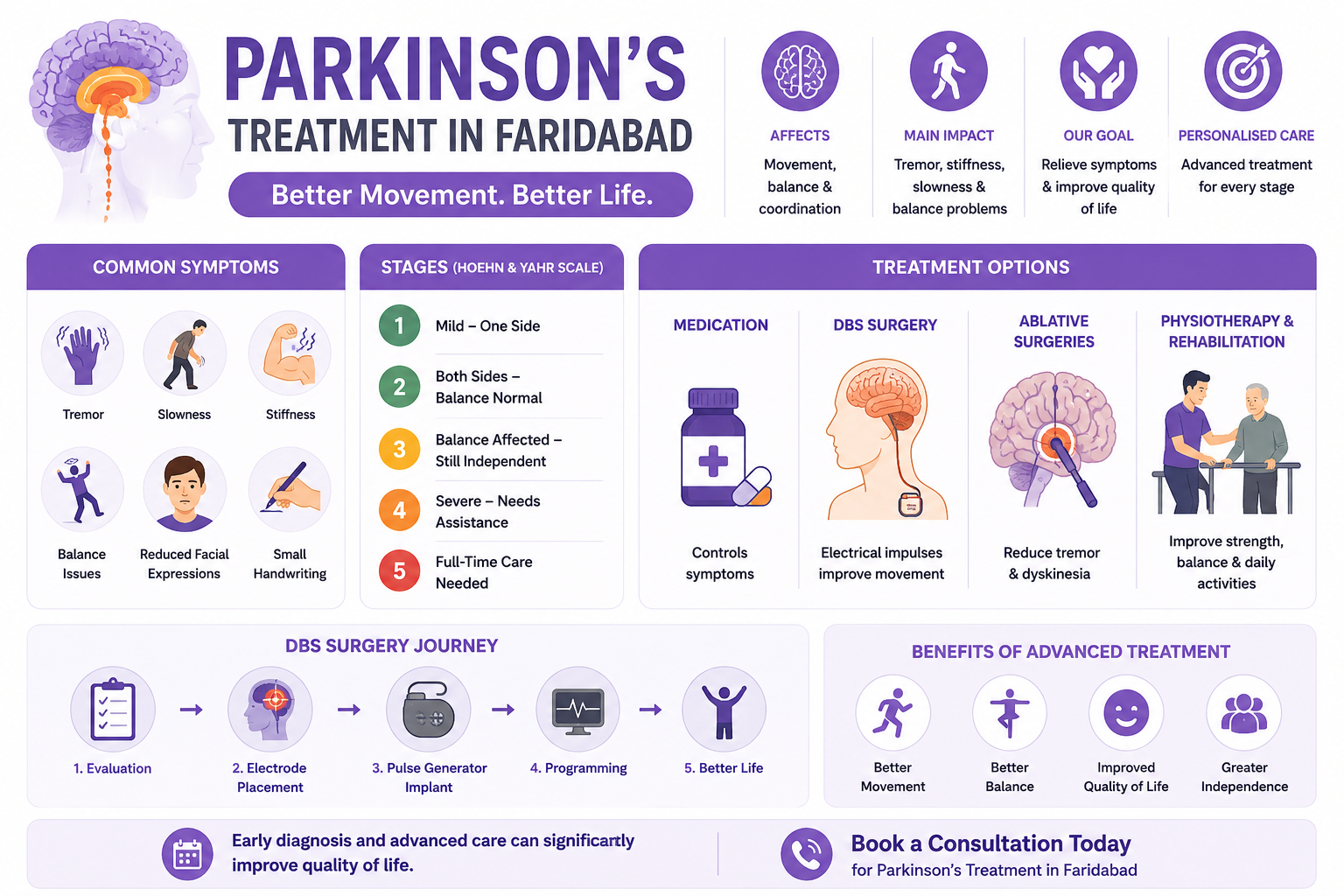
Stages of Parkinson’s Disease (Hoehn and Yahr Scale)
Parkinson’s disease progresses gradually through recognisable stages. Understanding the stage helps guide treatment decisions and set realistic expectations.
| Stage | Description |
| Stage 1 | Mild symptoms on one side of the body; minimal functional impairment |
| Stage 2 | Symptoms on both sides; balance generally preserved |
| Stage 3 | Mild to moderate bilateral involvement; balance problems; still independent |
| Stage 4 | Severe symptoms; significant disability; limited independent living |
| Stage 5 | Wheelchair-bound or bedridden; full-time care required |
Early diagnosis and timely intervention can significantly slow progression and improve functional independence.
Symptoms of Parkinson’s Disease
Parkinson’s disease presents with a wide range of motor and non-motor symptoms. These vary between individuals and may appear gradually over years.
Motor Symptoms:
- Resting tremor (involuntary shaking, often starting in one hand)
- Bradykinesia (slowness of movement)
- Muscle rigidity and stiffness
- Postural instability and balance problems
- Shuffling gait or difficulty initiating walking
- Reduced facial expressions (hypomimia)
- Micrographia (small, cramped handwriting)
Non-Motor Symptoms:
- Sleep disturbances (REM sleep behaviour disorder)
- Depression, anxiety, and apathy
- Cognitive changes and dementia in advanced stages
- Autonomic dysfunction (constipation, urinary problems, low blood pressure)
- Loss of smell (anosmia)
- Fatigue and pain
Risk Factors for Parkinson’s Disease
While Parkinson’s can affect anyone, certain biological, genetic, and environmental factors are known to increase the likelihood of developing the condition.
- Age above 60 years
- Male gender (men are 1.5 times more likely to develop Parkinson’s)
- Family history of Parkinson’s or related movement disorders
- History of head injury or repeated concussions
- Prolonged exposure to environmental toxins
- Prior diagnosis of REM sleep behaviour disorder
How is Parkinson’s Disease Diagnosed?
There is no single definitive test for Parkinson’s disease. Diagnosis is primarily clinical, based on a thorough neurological examination and medical history. Dr. Satyakam Baruah uses a structured evaluation process to accurately diagnose and stage the condition.
Diagnostic Approaches:
- Neurological Examination: Assessment of tremor, rigidity, bradykinesia, gait, and reflexes by a trained neurosurgeon.
- MRI Brain: Rules out other structural causes such as brain tumours or vascular lesions that may mimic Parkinson’s symptoms.
- DaTscan (Dopamine Transporter Scan): A specialised nuclear imaging test that evaluates dopaminergic activity in the brain to support diagnosis.
- Levodopa Response Test: A trial of levodopa medication – a significant improvement in symptoms strongly supports the Parkinson’s diagnosis.
- Cognitive and Psychological Assessment: To evaluate non-motor features including memory, mood, and behaviour.
Parkinson’s Treatment Options in Faridabad
Treatment is personalised based on the stage of disease, severity of symptoms, age, overall health, and how well the patient responds to medication. Dr. Satyakam Baruah at Amrita Hospital, Faridabad follows a structured, multidisciplinary approach to Parkinson’s management.
Medical Management
Medications remain the first line of treatment for Parkinson’s disease and are effective, particularly in the early stages.
- Levodopa-Carbidopa: The most effective medication for Parkinson’s; replenishes dopamine levels in the brain.
- Dopamine Agonists: Stimulate dopamine receptors directly (pramipexole, ropinirole).
- MAO-B Inhibitors: Prevent the breakdown of dopamine, prolonging its effect (selegiline, rasagiline).
- COMT Inhibitors: Extend the effect of levodopa by blocking its breakdown.
- Anticholinergics: Primarily used to control tremor, especially in younger patients.
Over time, medications may lose effectiveness or cause side effects such as involuntary movements (dyskinesias) and motor fluctuations (“on-off” phenomenon). At this stage, surgical options are carefully considered.
Deep Brain Stimulation (DBS) Surgery
Deep Brain Stimulation is one of the most significant advances in Parkinson’s treatment and is offered as part of neuromodulation treatment in Faridabad by Dr. Satyakam Baruah. DBS involves the surgical implantation of electrodes into precise targets within the brain – most commonly the subthalamic nucleus (STN) or the globus pallidus internus (GPi). These electrodes deliver controlled electrical impulses that modulate abnormal neural activity and reduce Parkinson’s symptoms.
DBS is particularly effective for:
- Disabling tremor that does not respond to medication
- Motor fluctuations and “off” periods
- Levodopa-induced dyskinesias
- Patients who respond well to levodopa but experience inconsistent benefit
Unlike ablative procedures, DBS is fully reversible and adjustable – stimulation parameters can be fine-tuned over time as the disease progresses.
Thalamotomy and Pallidotomy
For carefully selected patients where DBS may not be suitable, ablative procedures such as thalamotomy and pallidotomy may be considered. These procedures use precise surgical lesioning of specific brain targets to reduce tremor or dyskinesia. Thalamotomy is particularly effective for medication-resistant tremor.
Focused Ultrasound (MRgFUS)
A non-invasive option for tremor-dominant Parkinson’s in eligible patients, using precisely focused ultrasound waves to create a therapeutic lesion in the thalamus – without any surgical incision.
Physiotherapy and Rehabilitation
Rehabilitation plays a central role in managing Parkinson’s at every stage. A structured programme may include physiotherapy to improve gait, balance, and posture; occupational therapy to maintain independence in daily tasks; and speech therapy to address difficulties with voice volume, swallowing, and communication.
Struggling with Seizures, Persistent Headaches, or Other Neurological Symptoms?
Deep Brain Stimulation Surgery for Parkinson’s in Faridabad: What to Expect?
DBS surgery is a highly precise procedure performed under specialist neurosurgical care. In Faridabad, Dr. Satyakam Baruah uses advanced neuronavigation technology to ensure accurate electrode placement with maximum safety.
Before Surgery
- Comprehensive neurological and neuropsychological evaluation
- MRI brain for surgical planning and target localisation
- Multidisciplinary review involving neurosurgeon, neurologist, and anaesthetist
- Medication review and optimisation
- Discussion of expectations, risks, and recovery with the patient and family
During Surgery
- Performed under local or general anaesthesia depending on the technique used
- Stereotactic frame or frameless navigation system placed for precision targeting
- Electrodes implanted into the brain target (STN or GPi) via small burr holes
- Intraoperative testing to confirm optimal electrode placement
- Pulse generator (neurostimulator) implanted under the skin, typically below the collarbone, in a separate session
After Surgery
- Monitoring in the neuro-ICU followed by transfer to ward
- Initial DBS programming and stimulation adjustment
- Post-operative MRI or CT to confirm lead position
- Hospital stay: typically 3–7 days
- Regular outpatient follow-up for DBS programming and medication adjustment
Recovery After Parkinson’s Treatment
Recovery and outcomes vary based on the stage of disease, treatment chosen, and individual patient factors.
After DBS Surgery:
- Most patients experience significant improvement in tremor, rigidity, and motor fluctuations
- Return to light daily activities within 2–4 weeks
- DBS programming is adjusted over several months to optimise benefit
- Medications may be reduced (though rarely stopped entirely)
Ongoing Management:
- Regular neurological review and DBS parameter optimisation
- Physiotherapy to maintain strength, balance, and gait
- Speech therapy for voice and swallowing support
- Occupational therapy for activities of daily living
- Monitoring and management of non-motor symptoms
Cost of Parkinson’s Treatment in Faridabad
The cost of Parkinson’s treatment in Faridabad varies based on the treatment approach, stage of disease, and hospital facilities required.
| Treatment Type | Approximate Cost Range |
| Medical management (medications + OPD) | ₹3,000 – ₹15,000 per month |
| DBS Surgery (both sides) | ₹8,00,000 – ₹14,00,000 |
| Thalamotomy / Pallidotomy | ₹3,00,000 – ₹6,00,000 |
| Physiotherapy and rehabilitation | ₹500 – ₹2,000 per session |
Key factors that influence cost include the type of DBS device used (rechargeable vs. non-rechargeable), whether the procedure is unilateral or bilateral, duration of hospital stay, ICU care, and post-operative rehabilitation.
A personalised consultation with Dr. Satyakam Baruah is essential to determine the most appropriate treatment plan and receive an accurate parkinson’s treatment cost in Faridabad estimate.
Why Patients Trust Dr. Satyakam Baruah for Parkinson’s Treatment in Faridabad?
Choosing the right neurosurgeon for Parkinson’s treatment – particularly for DBS surgery – is a critical decision. Patients from across Faridabad, Delhi NCR, and neighbouring states trust Dr. Satyakam Baruah because of his:
- 20+ Years of Neurosurgical Experience with specialised training in functional neurosurgery and neuromodulation
- Expertise in DBS, Thalamotomy, and Pallidotomy for movement disorders
- Advanced Neuronavigation Technology ensuring precise, safe electrode placement
- Multidisciplinary, Patient-Centred Approach involving neurologists, physiotherapists, and rehabilitation specialists
- Training from Premier Institutes including NIMHANS, Bangalore and Montreal Neurological Institute, Canada
- Trusted by Patients from Faridabad, Gurgaon, South Delhi, Noida, Rohtak, and beyond
Book a Consultation for Parkinson’s Treatment in Faridabad
Parkinson’s disease is a long-term condition, but with the right specialist and a structured treatment plan, many patients lead active, fulfilling lives for years after diagnosis. Whether you are newly diagnosed, experiencing medication side effects, or exploring surgical options such as DBS, Dr. Satyakam Baruah offers expert, compassionate guidance at every stage.
During your consultation:
- Detailed review of symptoms, medical history, and current medications
- Neurological examination and movement assessment
- MRI and relevant imaging review
- Discussion of disease stage and treatment options (medical and surgical)
- Honest explanation of risks, expected outcomes, and recovery
- Personalised recommendations based on your specific condition and goals
Timely evaluation helps avoid preventable complications, optimise medication management, and ensure surgical candidacy is assessed at the right time.
Frequently Asked Questions (FAQs)
1. Is Parkinson’s disease curable?
There is currently no cure for Parkinson’s disease, but its symptoms can be effectively managed through medication, Deep Brain Stimulation surgery, and rehabilitation. Many patients maintain good quality of life for years with appropriate treatment.
2. When should DBS surgery be considered for Parkinson’s?
DBS surgery is typically considered when motor symptoms are no longer adequately controlled by medication alone, when significant motor fluctuations or dyskinesias develop, or when medication side effects become difficult to manage. Ideal candidates are those who have shown a good response to levodopa and do not have significant cognitive impairment.
3. Is DBS surgery safe?
DBS is an established, well-studied surgical procedure. When performed by an experienced neurosurgeon using advanced neuronavigation, the risks are well-understood and manageable. Potential risks include infection, bleeding, hardware complications, and lead misplacement – all of which are addressed through careful planning and post-operative monitoring.
4. How long does DBS benefit last?
DBS provides long-term benefit for many patients, with studies showing sustained improvement in motor function for 10 years or more. The stimulator settings can be adjusted over time as the disease progresses, and the battery (neurostimulator) is replaced when needed.
5. Can Parkinson’s disease affect younger people?
Yes. While Parkinson’s most commonly affects people over 60, early-onset Parkinson’s (before age 50) accounts for roughly 5–10% of all cases. Younger patients often have a different symptom profile and may benefit significantly from early DBS surgery.
6. What is the difference between Parkinson’s disease and essential tremor?
Essential tremor primarily causes action tremor (shaking during movement) and most commonly affects the hands and head. Parkinson’s tremor is typically a resting tremor (shaking at rest) and is accompanied by other features such as bradykinesia and rigidity. A specialist evaluation is important to differentiate the two, as treatment approaches differ.

Dr. Satyakam Baruah’s Medical Content Team
Dr. Satyakam Baruah’s medical content team specialises in creating accurate, clear, and patient-focused healthcare content. With strong clinical understanding and expertise in technical writing and SEO, the team translates complex medical information into reliable, accessible resources that support informed decisions and uphold Dr. Satyakam's commitment to quality care.
This content is reviewed by Dr. Satyakam Baruah
Related Blogs
World Parkinson’s Day: Bridge the Care Gap
World Parkinson’s Day is observed every year on 11th April, and it carries a message…
Read Article → WhatsApp