LOOP-X Robotic Imaging: Advancing Neurosurgery in India
Early Diagnosis Saves Lives - Book an Appointment Today with Dr Satyakam Baruah!
Two Days. Two Surgical Milestones. One Leap Forward.
I want to share something that genuinely moved me – not just as a surgeon, but as someone who has spent over two decades believing that world-class neurosurgical care must reach every patient who needs it, wherever they are.
Over two consecutive days at Amrita Hospital, Faridabad, we performed two landmark procedures using the LOOP-X Robotic Imaging System by Brainlab. Day 1: a deep brain stimulation (DBS) surgery. Day 2: a Unilateral Biportal Endoscopic (UBE) spine surgery.
Two very different operations. Two very different patient journeys. One shared thread – the kind of precision and intraoperative confidence that, until recently, was only available at a handful of centres globally.
That thread is now woven into our operating rooms here in Faridabad.
This post is for patients, families, and colleagues who want to understand what happened, why it matters, and what it means for anyone seeking advanced neurosurgery in India.
What Is the LOOP-X Robotic Imaging System?
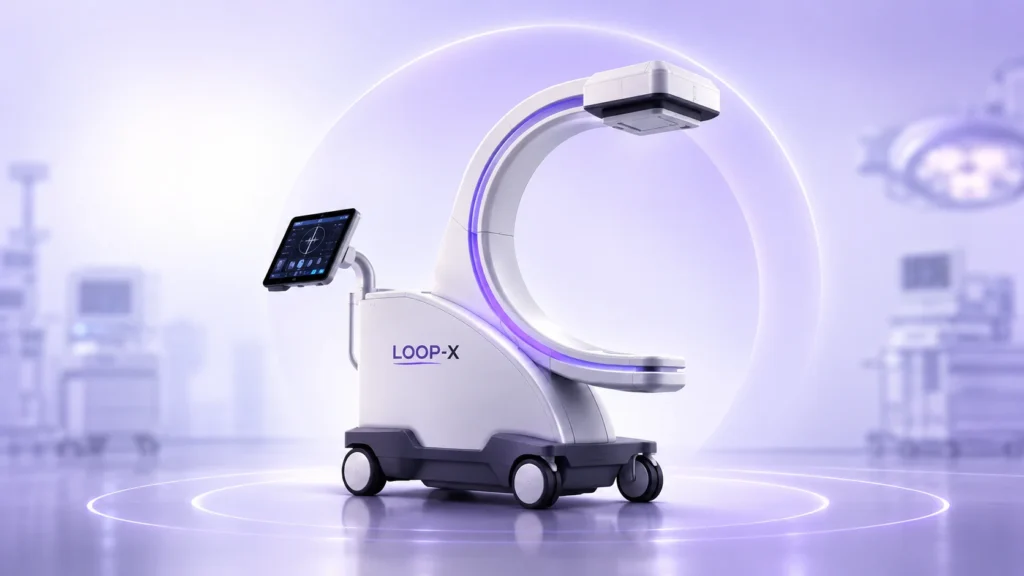
The LOOP-X is a mobile robotic intraoperative imaging system developed by Brainlab. In plain language: it’s a compact, intelligent imaging robot that comes into the operating theatre and gives us real-time 2D and 3D CBCT (cone-beam CT) images of the patient – while surgery is in progress.
Here’s what makes it different from a standard C-arm or fluoroscope:
- Submillimetre robotic accuracy – the source and detector move independently, enabling non-isocentric imaging tailored precisely to the patient’s anatomy.
- Large 121 cm bore – accommodates patients in prone, supine, or lateral positions without repositioning.
- 43 cm × 43 cm flat-panel detector – broad coverage in a single spin, with scan volumes up to 48 cm diameter.
- Wireless remote control – operated with a touchscreen and joystick panel, keeping the surgical field uncluttered.
- Seamless BRAINLAB neuronavigation integration – intraoperative scans register automatically to the navigation system, updating the surgical roadmap in real time.
- Fluoroscopic platform capability – provides standard 2D fluoroscopic imaging as well, reducing the need for multiple devices and cutting cumulative radiation exposure for both patient and theatre staff.
Think of it as the difference between navigating with a paper map and navigating with live GPS that updates every second. Both get you there. Only one tells you if the road has changed.
Day 1 – Deep Brain Stimulation (DBS) Surgery with LOOP-X
What Is DBS Surgery?
Deep brain stimulation surgery is a neurosurgical procedure in which thin electrodes – called leads – are implanted into precisely targeted areas deep within the brain. These leads connect to a small pulse generator (similar to a cardiac pacemaker) placed under the skin near the collarbone. The generator delivers continuous, carefully calibrated electrical impulses that modulate abnormal brain circuit activity.
DBS surgery is FDA-approved and evidence-backed for several conditions:
- Parkinson’s disease – the most established indication; DBS significantly reduces tremor, rigidity, and medication-related motor fluctuations.
- Essential tremor – often dramatically effective, with many patients experiencing near-complete tremor relief.
- Dystonia – abnormal, sustained muscle contractions that cause twisting postures.
- Drug-resistant epilepsy – DBS targeting the anterior nucleus of the thalamus (ANT) is approved for seizure reduction in medication-resistant cases.
- Obsessive-compulsive disorder (OCD) – used selectively in severe, treatment-resistant cases.
- Depression – investigational, with growing evidence in refractory cases.
The procedure works by modulating dysfunctional neural circuits – not destroying tissue, but tuning the brain’s electrical environment. It is reversible, adjustable, and, in the right patient, life-changing.
Why does precision matter so much in DBS? Because the targets – the subthalamic nucleus, globus pallidus, thalamus, or anterior nucleus – are structures measured in millimetres, sitting adjacent to critical pathways. A lead placed even 1–2 mm off-target can mean the difference between excellent symptom control and inadequate benefit or unwanted side effects.
How LOOP-X Transformed This DBS Procedure
In traditional DBS surgery, lead placement is guided by preoperative MRI planning, stereotactic frame coordinates, and intraoperative microelectrode recording. It’s a rigorous process – but it relies heavily on the assumption that the brain hasn’t shifted between the preoperative scan and the moment of implantation. Brain shift is real. It happens. And it introduces uncertainty.
With LOOP-X integrated into our workflow, we were able to do something that changes the equation entirely: real-time 3D intraoperative verification of lead placement.
After placing the DBS lead, we acquired an intraoperative 3D CBCT scan. The LOOP-X automatically registered this scan to our BRAINLAB neuronavigation dataset. Within minutes, we could confirm – on screen, with millimetre-level confidence – that the lead was exactly where we intended it to be.
No guesswork. No “we’ll confirm on postoperative MRI and adjust if needed.” Confirmation in the theatre, before the patient leaves the table.
The integration with BRAINLAB neuronavigation was seamless. There was no disruption to surgical flow – the system registered automatically, the navigation updated, and we continued. For the patient, this means a single, well-placed procedure. For the family waiting outside, it means one less source of uncertainty.
Who Is a Candidate for DBS Surgery in India?
You or your loved one may be a candidate for DBS surgery if:
- Parkinson’s disease symptoms are no longer adequately controlled by medication, or if medication side effects (dyskinesias, wearing-off) are significantly impacting quality of life.
- Essential tremor is severe enough to interfere with daily activities – eating, writing, working – and has not responded to medication.
- Drug-resistant epilepsy persists despite trying two or more appropriate anti-seizure medications at adequate doses.
- Dystonia is causing significant disability and has not responded to botulinum toxin or oral medications.
- OCD is severe and has failed multiple medication trials and psychotherapy.
A thorough pre-surgical evaluation – including neurological assessment, neuroimaging, neuropsychological testing, and a multidisciplinary team discussion – is essential before any DBS surgery decision. This is not a procedure to rush. It’s one to plan carefully and execute precisely.
Day 2 – Unilateral Biportal Endoscopic (UBE) Spine Surgery with LOOP-X
What Is UBE Spine Surgery?
Unilateral Biportal Endoscopic (UBE) spine surgery is one of the most advanced forms of minimally invasive spine surgery available today. The name describes the technique exactly: unilateral (one side of the back), biportal (two small portals or incisions), endoscopic (using a camera for visualisation).
One portal accommodates the endoscope – a thin camera that streams high-definition video to a monitor. The other portal is the working channel, through which surgical instruments operate. The two portals work in concert, giving the surgeon a wide, clear field of view while keeping tissue disruption to an absolute minimum.
UBE spine surgery is used to treat:
- Lumbar disc herniation (slipped disc) causing leg pain or weakness
- Lumbar canal stenosis – narrowing of the spinal canal causing back and leg pain, especially on walking
- Foraminal stenosis – compression of nerve roots at the exit points of the spine
- Degenerative disc disease with nerve compression
- Recurrent disc herniation after previous surgery
Compared to traditional open spine surgery, UBE offers less muscle damage, less blood loss, less postoperative pain, and faster return to daily activities. Patients who once faced weeks of recovery are often mobilising within 24–48 hours.
How LOOP-X Reduced Radiation and Improved Outcomes
Spine surgery has always involved radiation. Fluoroscopy – the real-time X-ray imaging used to confirm instrument and implant positions – is a standard part of the workflow. But cumulative radiation exposure is a genuine concern: for the patient, and for the theatre team who stand in that room, case after case, year after year.
LOOP-X addresses this directly. As a fluoroscopic platform, it delivers targeted, collimated imaging – meaning the beam is focused precisely on the region of interest, not scattered broadly. Flexible scan volumes and low-dose imaging options reduce the total radiation dose compared to conventional fluoroscopy setups.
During our UBE spine surgery, LOOP-X gave us:
- Intraoperative 3D confirmation of decompression adequacy – we could verify that the nerve root was fully freed before closing.
- Reduced reliance on repeated fluoroscopic shots – fewer exposures, lower cumulative dose.
- Corridor clarity – the robotic positioning of the LOOP-X meant it could be moved in and out of the surgical field without disrupting the sterile setup or the operative team’s positioning.
The result: a procedure performed with the confidence of intraoperative imaging, and a patient who left the theatre knowing that the decompression was confirmed – not estimated.
Who Is a Candidate for UBE Spine Surgery in India?
UBE spine surgery may be appropriate if you have:
- Persistent leg pain, numbness, or weakness from a lumbar disc herniation that has not improved with 6–12 weeks of conservative treatment (physiotherapy, medications, injections).
- Neurogenic claudication – leg pain or heaviness that comes on with walking and is relieved by sitting – caused by lumbar canal stenosis.
- Foraminal stenosis causing radiating nerve pain (sciatica) that is not responding to non-surgical management.
- Recurrent disc herniation after a previous open discectomy.
Not every spine problem needs surgery. And not every spine surgery needs to be open. A careful clinical and radiological assessment – including MRI and sometimes CT – will determine whether UBE is the right approach for your specific anatomy and condition.
Why LOOP-X Is a Game Changer for Neurosurgical Care in India
We’ve been doing complex neurosurgery in India for decades. The surgical skills have always been here. What has sometimes lagged is the intraoperative technology to match those skills with the verification they deserve. LOOP-X closes that gap. Here’s how:
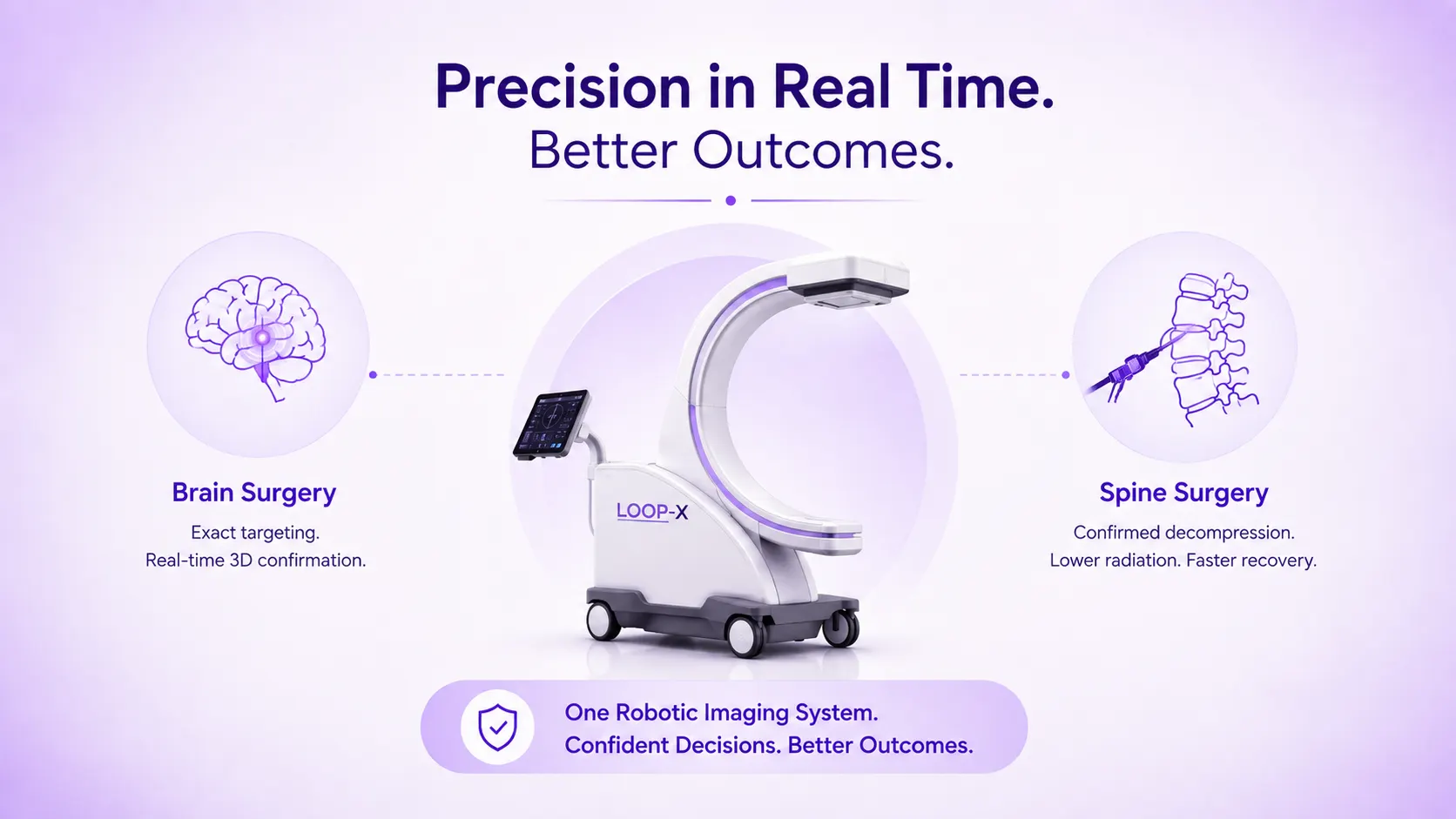
- Submillimetre accuracy in real time. For DBS surgery, where targets are measured in millimetres, this isn’t a luxury – it’s a necessity. LOOP-X’s robotic imaging delivers the spatial precision that functional neurosurgery demands.
- Seamless BRAINLAB neuronavigation integration. Intraoperative scans register automatically to the navigation system. The surgical roadmap updates without pausing the procedure. This is the kind of workflow integration that separates a good operating room from a great one.
- Significantly reduced radiation exposure. For patients undergoing spine surgery – and for the theatre teams who perform them day after day – lower cumulative radiation is a meaningful clinical and occupational health benefit. LOOP-X’s collimated, targeted imaging delivers this.
- Versatility across procedures. One system. Brain surgery. Spine surgery. Functional neurosurgery. The LOOP-X adapts to the procedure, not the other way around. This matters enormously in a busy neurosurgical centre where the case mix is wide.
- Intraoperative course correction. Perhaps most importantly: if something is not exactly right, we know before closing. We can adjust, re-verify, and confirm – all within the same operative episode. This is the single biggest shift in how intraoperative imaging changes surgical decision-making.
What This Means for Patients Seeking Advanced Neurosurgery in India
For years, patients and families have asked me: “Do we need to go abroad for this level of care?”
My answer, increasingly, is no.
The LOOP-X Robotic Imaging System at Amrita Hospital, Faridabad, represents a genuine benchmark – the same technology used at leading neurosurgical centres in Europe and North America, now available in Delhi NCR. Patients from across India – and from neighbouring countries – can access this level of care without the cost, stress, and logistical burden of international travel.
For patients specifically searching for robotic surgery in India, or for families navigating a diagnosis of Parkinson’s disease, drug-resistant epilepsy, or a complex spine condition, this matters practically. It means:
- Shorter travel distances – Faridabad is 30 minutes from South Delhi, easily accessible from Gurgaon, Noida, Rohtak, and Palwal.
- Continuity of care – follow-up, device programming (for DBS), and rehabilitation happen close to home.
- Globally benchmarked standards – NABH-accredited facility, internationally trained surgical team, and now, LOOP-X intraoperative imaging.
As for my own training: I completed my MCh Neurosurgery at NIMHANS, Bangalore – India’s premier neuroscience institution – and my subspecialty fellowship in Epilepsy Surgery at the Montreal Neurological Institute, McGill University, Canada, one of the world’s foremost epilepsy surgery centres. I’ve performed over 5,000 neurosurgical procedures and treated more than 2,000 epilepsy patients. I share this not to impress, but to reassure: the expertise behind these procedures has been built over decades, across continents, and is now fully committed to patients here in Faridabad.
The best neurosurgeon for you is one who combines the right training, the right technology, and the right approach to your specific condition. We’re working every day to be that for every patient who walks through our doors.

 WhatsApp