Beyond Seizures: What Life Looks Like After Successful Epilepsy Surgery

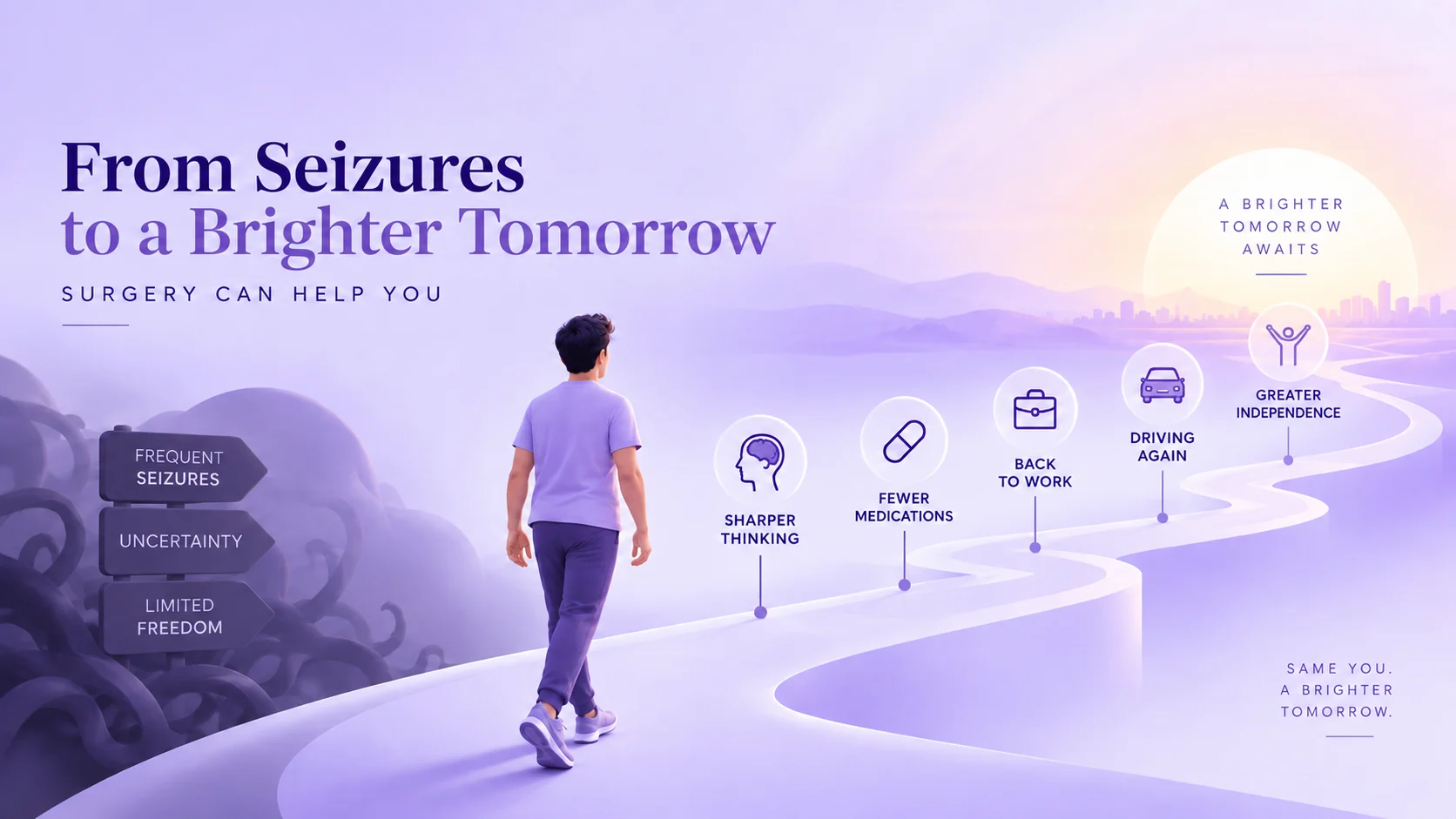
Epilepsy surgery achieves seizure freedom in 60–70% of carefully selected patients with drug-resistant epilepsy. Recovery unfolds over six to twelve months – medications taper gradually, cognitive function improves, and independence is progressively restored. Most patients return to work within six to twelve weeks, with driving resuming after a minimum six-month seizure-free period and neurologist clearance.
Early Diagnosis Saves Lives - Book an Appointment Today with Dr Satyakam Baruah!
Life After Epilepsy Surgery: The First Few Months
The early weeks after surgery bring real change – but also real adjustment. This section covers what patients typically experience in the first few months: the gains, the surprises, and the things that take a little longer than expected.
- The absence of seizures reshapes daily life. Most patients describe a strange, welcome quiet in the weeks after surgery – the hypervigilance that came with epilepsy simply lifts. Quality of life after epilepsy surgery improves across almost every dimension researchers measure: mood, independence, social participation, and self-esteem. A 2022 systematic review found surgery improved quality of life in more than half of adults with drug-resistant epilepsy, with seizure freedom as the strongest single predictor.
- Becoming seizure-free after surgery is a process, not a switch. The brain has spent years organising itself around seizure activity. Once that stops, it needs time to reorganise. Some patients go through a period of emotional adjustment even when surgery has gone perfectly – identity shifts, and shedding the label “person with epilepsy” can feel disorienting alongside the relief. This is normal, and it passes.
- Medications don’t disappear overnight. Most patients continue antiepileptic drugs for at least one to two years post-surgery, even when completely seizure-free. This is a deliberate precaution while the brain stabilises – not a sign that surgery failed. Tapering happens gradually, guided by EEG findings and clinical judgment.
- Cognitive changes are real – and usually positive. Patients frequently report sharper thinking and better memory as medication burdens reduce. Temporal lobe epilepsy surgery outcomes in this area are well-documented: when the seizure focus is removed cleanly, cognitive function tends to improve over six to twelve months, not decline.
- Mood fluctuations in the early months are expected. Anxiety and low mood can linger, especially if seizure freedom isn’t immediate. Dr. Satyakam Baruah, Senior Consultant Neurosurgeon at Amrita Hospital Faridabad, builds psychological follow-up into his post-operative care model as a matter of course – not an afterthought. Having managed more than 2,000 epilepsy patients over a career spanning 20-plus years, he has seen firsthand that the surgical outcome and the psychological outcome need to be managed together.
Seizure Freedom and What It Really Feels Like
Seizure freedom is the goal – but what does it actually mean to live it? This section explores the emotional and practical reality of being seizure-free after surgery, beyond what the clinical data captures.
- The epilepsy surgery success rate is genuinely encouraging. For temporal lobe epilepsy surgery – the most common type – approximately 60–70% of carefully selected patients become seizure-free. A 2023 meta-analysis reported around 70% seizure freedom for medically refractory epilepsy following temporal lobe resection. Across all focal epilepsy types, studies consistently report 50–70% of patients achieving meaningful seizure reduction or complete freedom at two years.
- Can epilepsy be cured by surgery? For the right candidate, surgery offers the closest thing to a functional cure that epilepsy medicine currently has. For temporal lobe epilepsy caused by mesial temporal sclerosis, around two-thirds of patients achieve Engel Class I outcomes – meaning no disabling seizures. A small percentage experience recurrence years later, which is why long-term follow-up matters even after excellent early results.
- The emotional weight of freedom is real. Patients often describe the first seizure-free months as emotionally complex – relief, disbelief, and sometimes a kind of grief for the years lost to the condition. Peer support and structured follow-up help enormously during this period.
- Long-term outcomes hold up well. Research shows that many patients maintain seizure freedom at five and ten years, particularly those with mesial temporal lobe epilepsy. The first year is the most telling – which is why patience and consistent follow-up in that window genuinely matter.
Getting Back to Everyday Life
Epilepsy surgery recovery follows a broadly predictable arc, but the pace is personal. This section covers the practical journey – from hospital discharge to returning to work, driving, and the routines that drug-resistant epilepsy had quietly taken away.
- Hospital discharge happens sooner than most people expect. Most patients spend three to seven days in hospital after surgery. The first two weeks at home are about rest – fatigue, mild headaches, and some emotional ups and downs are all normal and almost always resolve on their own. Light activity typically resumes within two to four weeks.
- Returning to work after epilepsy surgery is a realistic, near-term goal. Most patients reach this milestone within six to twelve weeks, depending on their role. Desk-based work is often resumed sooner; physically demanding or safety-critical positions may require a longer clearance period and written sign-off from the surgical team. Employment rates rose significantly in the years following successful surgery – seizure freedom opened doors that epilepsy had quietly closed.
- Driving after epilepsy surgery requires patience and formal clearance. This is one of the questions patients ask most urgently. In India, the standard clinical recommendation is a minimum of six months of seizure freedom before resuming driving, with a neurologist’s written fitness opinion and confirmation from the local RTO. For most patients, getting back behind the wheel is one of the most emotionally significant milestones of recovery – a concrete symbol of independence regained.
- Recovery is measured in months, not weeks. The brain continues healing long after the incision closes. Seizure outcomes are formally assessed at the one-year mark, and follow-up appointments are where medication adjustments happen, EEG trends are tracked, and anything that needs attention is caught early.
- The infrastructure behind follow-up care matters enormously. Dr. Baruah completed a fellowship at the Montreal Neurological Institute, McGill University, Canada – one of the world’s foremost epilepsy surgery centres – before returning to India to build a programme that brings those international standards home. For patients across Delhi NCR seeking epilepsy surgery in Faridabad or epilepsy surgery in India more broadly, that combination of international training and institutional rigour is exactly what a complex surgical journey demands.
Is Epilepsy Surgery the Right Choice?
Surgery isn’t the right answer for everyone – but far more people are candidates than realise it. This section looks at what the evidence says about outcomes, and what the evaluation process actually involves.
- Drug resistance is the key trigger for a surgical conversation. Clinically, drug-resistant epilepsy is defined as failure of two appropriately chosen and tolerated medications. If that threshold has been reached, surgery deserves a serious conversation – not a footnote at the end of a clinic appointment. The question isn’t whether surgery is a last resort; it’s whether waiting longer is costing someone years of their life.
- The pre-surgical workup is thorough by design. A comprehensive evaluation typically includes video-EEG monitoring, high-resolution MRI, neuropsychological testing, and sometimes intracranial EEG or stereo-EEG. This isn’t bureaucracy – it’s the process that determines whether surgery is safe, where exactly to operate, and what outcomes are realistic for that individual.
- A range of surgical options means the plan can be truly tailored. Not every patient needs the same operation. Dr. Baruah holds an MCh in Neurosurgery from NIMHANS, Bangalore – one of India’s most respected neuroscience institutions – and trained further at the Montreal Neurological Institute, McGill University. He offers the full spectrum: resection, robotic stereo-EEG guided surgery, and neuromodulation. Having access to every tool means the plan is built around the patient, not around what happens to be available.
- Waiting has its own costs. Every year of uncontrolled seizures carries risks – injury, cognitive decline, social withdrawal, lost employment. For the right candidate, the evidence is clear: earlier surgical evaluation leads to better outcomes. The question worth asking isn’t “is surgery too drastic?” – it’s “what is continued waiting actually costing?”
Why More Patients Are Choosing Surgery Over Lifelong Medication
The conversation around epilepsy surgery has shifted. This section explores why more patients and neurologists are choosing surgery earlier – and what that means for long-term quality of life after epilepsy surgery.
- Medication has real limits. For roughly one in three people with epilepsy, seizures continue despite trying multiple drugs. That’s not a failure of willpower or adherence – it’s biology. Drug-resistant epilepsy is a clinical reality, and surgery is the evidence-based response to it.
- The risk-benefit calculation has changed. Surgical techniques have advanced significantly. Minimally invasive approaches like LITT and robotic stereo-EEG have reduced recovery times and expanded the pool of candidates who can safely undergo surgery. The risks of surgery, in experienced hands, are now often lower than the cumulative risks of years of uncontrolled seizures.
- Quality of life data makes a compelling case. Studies consistently show that patients who achieve seizure freedom through surgery report dramatically better quality of life than those who remain on medication without seizure control. Employment, relationships, mental health, and independence all improve – and those gains tend to be durable.
- Surgery is not giving up on medication – it’s choosing a better option. Many patients who achieve seizure freedom after surgery eventually taper off medication entirely. Surgery and medication aren’t in opposition; surgery is often what makes a medication-free life possible.
Why Patients Choose Dr. Satyakam Baruah for Epilepsy Surgery in Faridabad
Choosing an epilepsy surgeon is one of the most consequential decisions a family will make. Beyond Seizures was built around a surgeon whose training, experience, and philosophy reflect exactly what that decision demands.
- Dr. Satyakam Baruah completed his MCh in Neurosurgery at NIMHANS, Bangalore – India’s premier neuroscience institution – followed by a fellowship at the Montreal Neurological Institute, McGill University, one of the founding centres of modern epilepsy surgery. Over a career spanning 20-plus years, he has performed more than 5,000 neurosurgical procedures and personally managed over 2,000 epilepsy patients.
- He offers the full range of surgical options – resection, stereo-EEG guided surgery, and neuromodulation – so every treatment plan is built around the patient, not around what happens to be available.
- Dr. Baruah practises at Amrita Hospital, Faridabad, which is both NABH and NABL accredited – independently verified standards that matter for families travelling from across India.
- If you or someone you love is living with drug-resistant epilepsy, Beyond Seizures exists so you can understand your options clearly, and connect with a team that has the experience to help.

 WhatsApp