When Seizures Don’t Stop: Drug Resistant Epilepsy

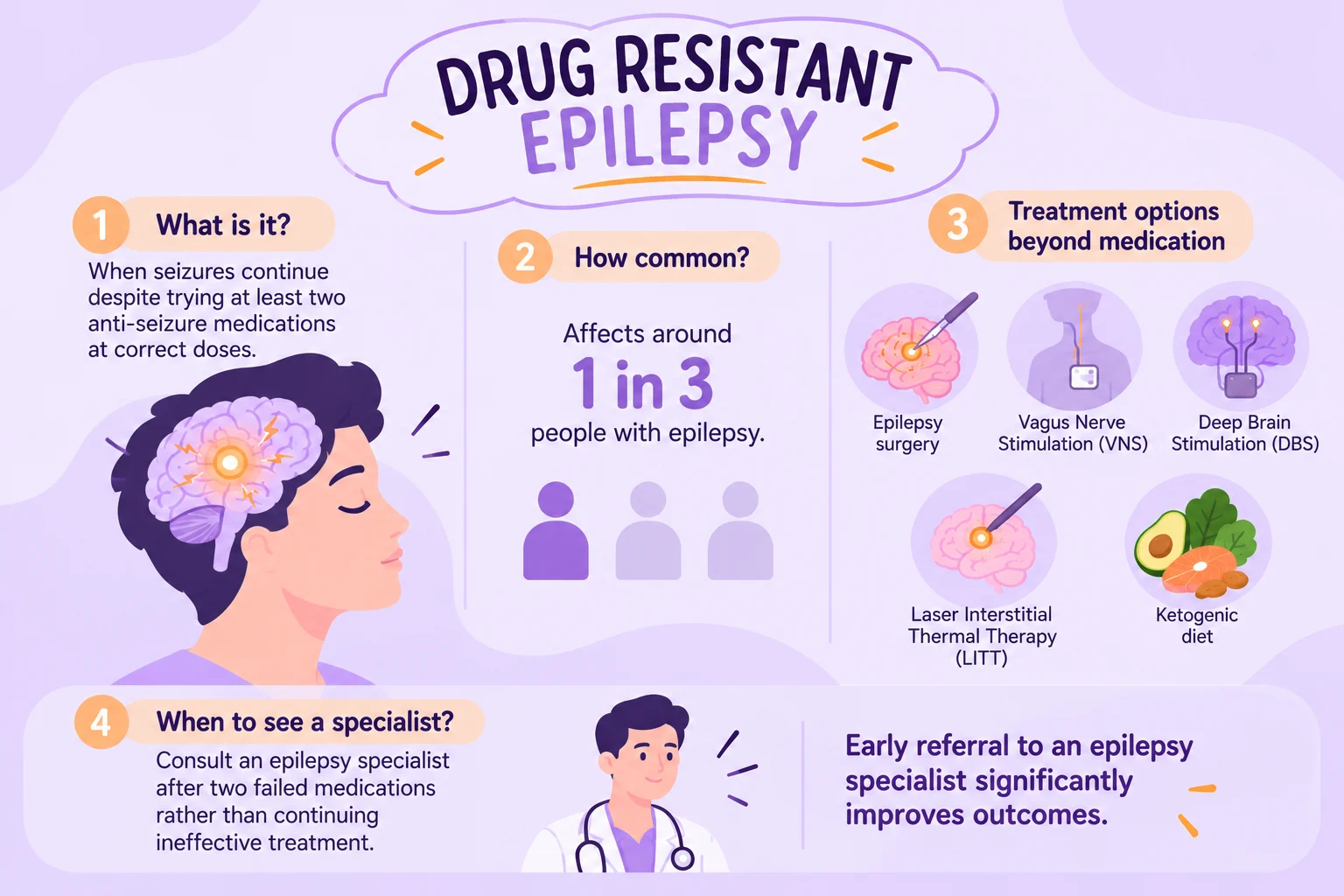
Drug resistant epilepsy is diagnosed when seizures continue despite trying at least two appropriate anti-seizure medications at correct doses. It affects approximately one in three people with epilepsy. Treatment options beyond medication include epilepsy surgery, Vagus Nerve Stimulation (VNS), Deep Brain Stimulation (DBS), Laser Interstitial Thermal Therapy (LITT), and the ketogenic diet. Early referral to an epilepsy specialist significantly improves outcomes. Patients should seek Drug Resistant Epilepsy specialist evaluation after two failed medications rather than continuing ineffective treatment. In India, Drug Resistant Epilepsy treatment costs between Rs. 2,00,000 and Rs. 6,00,000+.
Early Diagnosis Saves Lives - Book an Appointment Today with Dr Satyakam Baruah!
What is drug resistant epilepsy?
Drug resistant epilepsy, also called refractory epilepsy or intractable epilepsy, is diagnosed when seizures continue despite adequate trials of at least two appropriately chosen and correctly dosed anti-seizure medications. The seizures may continue unchanged, reduce only temporarily, or fail to respond at all to treatment.
Reaching this diagnosis is not a sign of personal failure. It is a clinical signal that the brain requires a different strategy, and that signal should prompt early referral to an epilepsy specialist rather than continued cycling through medications without deeper investigation. Research shows that around one in three people with epilepsy may develop drug resistance at some point, making it far more common than many families expect.
Why do some seizures not respond to medication?
There is rarely a single reason why epilepsy becomes drug resistant. Common contributing factors include an incorrect diagnosis or seizure classification, since generalized, focal, and subtle seizures often require entirely different treatment approaches. There may also be a mismatch between the medication chosen and the patient’s specific epilepsy type or the brain network involved. Underlying structural brain abnormalities such as cortical dysplasia, hippocampal sclerosis, vascular malformations, or tumors can make seizures harder to control with medication alone. In some cases, true pharmacological resistance develops through changes in how brain cells respond to drugs over time, or through genetic factors that reduce medication effectiveness.
This is why a thorough re-evaluation by an epilepsy specialist is so important. What appears to be another failed medication may actually point to a diagnosable and treatable root cause that was missed earlier. Getting to the root cause changes everything.
Advanced treatment options for drug resistant epilepsy
The field of refractory epilepsy treatment has advanced significantly. Patients who do not respond to standard medications now have access to several highly effective pathways.
Medication optimization is often the first step. A specialist review may reveal better drug combinations, adjusted doses, or newer-generation anti-seizure medications with improved efficacy and fewer side effects. For some patients, this step alone achieves meaningfully better control.
Epilepsy surgery is one of the most effective solutions for suitable patients. When seizures originate from an identifiable, non-critical area of the brain, surgical removal or disconnection of that region can be highly effective and in many cases curative. Modern techniques have made epilepsy surgery in India safer, more precise, and less invasive than ever before. These include robotic-assisted Stereo-EEG for accurate seizure mapping and Laser Interstitial Thermal Therapy (LITT), a minimally invasive option with shorter recovery times. Success rates are excellent in carefully selected patients, with many achieving long-term seizure freedom.
For patients who are not ideal surgical candidates, neuromodulation devices offer another effective path. Vagus Nerve Stimulation (VNS) delivers regular electrical pulses to the vagus nerve to reduce seizure frequency and severity. Deep Brain Stimulation (DBS) targets specific brain nuclei to modulate abnormal electrical activity. Responsive Neurostimulation (RNS), available at select centers, detects abnormal brain signals and interrupts them in real time before a seizure develops.
Dietary therapies such as the ketogenic diet and its variations, including the modified Atkins diet and low glycemic index treatment, can be remarkably effective for Drug Resistant Epilepsy Treatment , particularly in children and in certain genetic epilepsies. These are medically supervised approaches that shift the brain’s energy metabolism to help reduce seizures.
The importance of a specialist-led evaluation
The cornerstone of successful drug resistant epilepsy management is a comprehensive diagnostic workup. This typically includes high-resolution MRI brain imaging, prolonged video-EEG monitoring to observe and localize actual seizures, functional imaging studies, and in some cases neuropsychological assessment or genetic testing. These investigations help create a detailed seizure map, identifying exactly where in the brain seizures begin and how they spread. This information guides every subsequent treatment decision.
A multidisciplinary team including epileptologists, neurosurgeons, neuropsychologists, radiologists, and dietitians ensures every angle is considered before any intervention is recommended. Early referral to a dedicated epilepsy center consistently produces better outcomes than years of medication trials without this deeper evaluation. Across Delhi NCR, Faridabad, and Gurgaon, access to this level of specialist expertise has improved significantly, allowing patients to receive world-class refractory epilepsy care closer to home.
Cost of Drug Resistant Epilepsy Treatment in India
Treatment costs of Drug resistant Epilepsy vary depending on the approach recommended. A pre-surgical evaluation typically ranges from Rs. 50,000 to Rs. 1,50,000+. Epilepsy surgery costs in India is between Rs. 2,00,000 and Rs. 6,00,000, while device-based therapies like VNS and DBS for Drug Resistant Epilepsy Treatment range from Rs. 4,00,000 to Rs. 15,00,000+. Many health insurance policies in India cover these procedures under surgical benefits.
Importantly, the long-term cost of uncontrolled seizures, including medications, emergency visits, and lost productivity, often exceeds the cost of definitive treatment.
When should you see an epilepsy specialist?
A clear and widely accepted guideline applies: if seizures continue after trying two appropriate anti-seizure medications at the correct doses, it is time to consult an Drug resistant epilepsy specialist. Do not wait for the condition to worsen or for more years of uncontrolled seizures to accumulate. Uncontrolled seizures affect work, school, relationships, driving eligibility, and overall quality of life. Every year of ongoing seizures carries real costs that early specialist evaluation can help prevent.
Patients from Gurgaon, Faridabad, Noida, and South Delhi are increasingly seeking early drug resistant epilepsy specialist opinions, not as a last resort, but as the logical next step in their care.
There is real hope for seizure freedom
Drug resistant epilepsy does not mean permanent seizure disability. Many patients who once felt completely stuck, having tried multiple medications without success, go on to achieve significant seizure reduction or complete seizure freedom after appropriate specialist intervention. Whether the right approach turns out to be refined medication, epilepsy surgery, a neuromodulation device, dietary therapy, or a combination, the key is moving forward with the right expertise guiding the way.
The possibility of a safer, more independent life is more within reach today than at any point in the history of epilepsy care. Taking that next step toward Drug resistant Epilepsy specialist evaluation could change everything.
Struggling with Seizures, Persistent Headaches, or Other Neurological Symptoms?
Consult an Epilepsy Specialist in Faridabad
Dr. Satyakam Baruah is a Senior Consultant Neurosurgeon in Faridabad, with over 20 years of experience and more than 2,000 epilepsy patients treated. He trained at NIMHANS Bangalore and completed a specialized Epilepsy Surgery Fellowship at the Montreal Neurological Institute, Canada, one of the world’s leading epilepsy centers. Patients from across Delhi NCR, Gurgaon, Noida, and South Delhi consult him for complex drug resistant epilepsy cases that others have found difficult to manage.
To book a consultation, call +91-9650708834 or visit beyondseizures.com. Seizure freedom may be possible, and your journey toward it can start now.

 WhatsApp