Is Epilepsy Hereditary?
In Summary – What You Need to Know
- Epilepsy is not always hereditary. About 30–40% of cases have a genetic basis, but many of those arise from spontaneous gene changes, not from a parent.
- If one parent has epilepsy, a child’s risk is roughly 2–5% – higher than the general population’s ~1%, but still meaning most children will not develop epilepsy.
- More than 300 genes have been linked to epilepsy. Key ones include SCN1A (Dravet syndrome) and KCNQ2 (neonatal seizures).
- Knowing the genetic cause can guide treatment, inform family planning, and – in drug-resistant cases – open the door to advanced epilepsy surgery.
Is Epilepsy Hereditary? Understanding the Genetic Link
“Did I pass this on to my child?” It’s one of the first questions a parent asks after a child is diagnosed with epilepsy. And for someone whose parent or sibling has the condition, the worry runs the other way: “Will I get epilepsy too?” These are completely understandable fears – and they deserve a clear, honest answer, not a vague reassurance.
This article walks through exactly what the science says: how often epilepsy is genetic, what the actual inheritance risks look like, which genes are involved, and what families can do with that information.
Epilepsy is a neurological condition in which the brain produces recurrent, unprovoked seizures. What causes epilepsy varies widely – from brain injuries and infections to tumours and, yes, genetics. The genetic link is real, but it’s more nuanced than a simple yes or no.
Early Diagnosis Saves Lives - Book an Appointment Today with Dr Satyakam Baruah!
What Does “Genetic Epilepsy” Actually Mean?
Here’s a distinction that matters: genetic does not automatically mean inherited.
A genetic epilepsy is one where a change (or variant) in a gene is the direct cause of the seizures. That variant can come from one of two places:
- Inherited from a parent – the gene change was already present in the family.
- De novo (spontaneous) – the gene change happened for the first time in the child, in the egg or sperm that led to conception. Neither parent carries it.
De novo mutations are surprisingly common in epilepsy, especially in severe early-onset cases. A child can have a genetic epilepsy with zero family history. That’s not a contradiction – it’s just how genetics works.
The genetic factors in epilepsy are also sometimes polygenic, meaning many small gene variations combine with environmental triggers rather than one single faulty gene causing everything.
How Common Is the Genetic Link in Epilepsy?
The numbers are significant, but they need context.
- 30–40% of all epilepsy cases are estimated to have a genetic basis.
- Scientists have now identified more than 300 genes linked to epilepsy – and that list keeps growing.
- A landmark study reported by the American Epilepsy Society found that 41% of adults with epilepsy of unknown cause had an identifiable genetic variant when tested.
That last figure is striking. It means a large number of people walking around with a diagnosis of “unknown cause” epilepsy may actually have a genetic epilepsy that simply hasn’t been identified yet.
Understanding what causes epilepsy in a given person – whether genetic, structural, metabolic, or unknown – is the foundation of good treatment. The causes of epilepsy in childhood, in particular, are more likely to have a genetic basis than adult-onset epilepsy.
Is Epilepsy Passed Down from Parents?
This is the question that keeps families up at night. Let’s look at the actual numbers.
If one parent has epilepsy, what is the child’s risk?
- Overall risk: 2–5% by age 20 (compared to about 1% in the general population).
- Mother with epilepsy: 2.9–8.7%
- Father with epilepsy: 1.0–3.6%
- Single-gene disorders (e.g., autosomal dominant): 25–50%
The reason the mother’s risk is slightly higher than the father’s is not fully understood, but it’s a consistent finding across multiple studies.
The most important takeaway: even if epilepsy is hereditary from parents, the majority of children of a parent with epilepsy will not develop epilepsy themselves. The risk is real but modest for most families.
The exception is single-gene disorders with a dominant inheritance pattern – in those cases, the risk can reach 25–50%. This is exactly why knowing the specific genetic cause matters so much.
Which Genes Are Linked to Epilepsy?
There are hundreds, but a handful are particularly well understood. Here’s what the key ones actually do – in plain language.
- SCN1A – This gene controls a sodium channel that helps regulate electrical signals in brain cells. Mutations in SCN1A are the primary cause of Dravet syndrome. Most SCN1A mutations in Dravet are de novo – meaning they arise fresh in the child, not passed down from a parent. SCN1A is also linked to GEFS+ (Generalised Epilepsy with Febrile Seizures Plus).
- KCNQ2 – This gene controls a potassium channel. Mutations here typically cause benign familial neonatal epilepsy – seizures that begin in the first days of life and often resolve within months. Some KCNQ2 variants cause a more severe early-infantile encephalopathy.
- STXBP1 – Affects how brain cells release neurotransmitters. Linked to severe early-onset epilepsy and developmental delay.
- PCDH19 – Unusual because it mainly affects girls. Linked to a specific epilepsy syndrome with fever-triggered seizures and behavioural difficulties.
- CDKL5 – Causes a severe developmental and epileptic encephalopathy with early-onset seizures and significant developmental challenges.
Each of these genes tells a different story. That’s why genetic testing isn’t just academic – it can directly change how a patient is treated.
Types of Genetic Epilepsy Syndromes
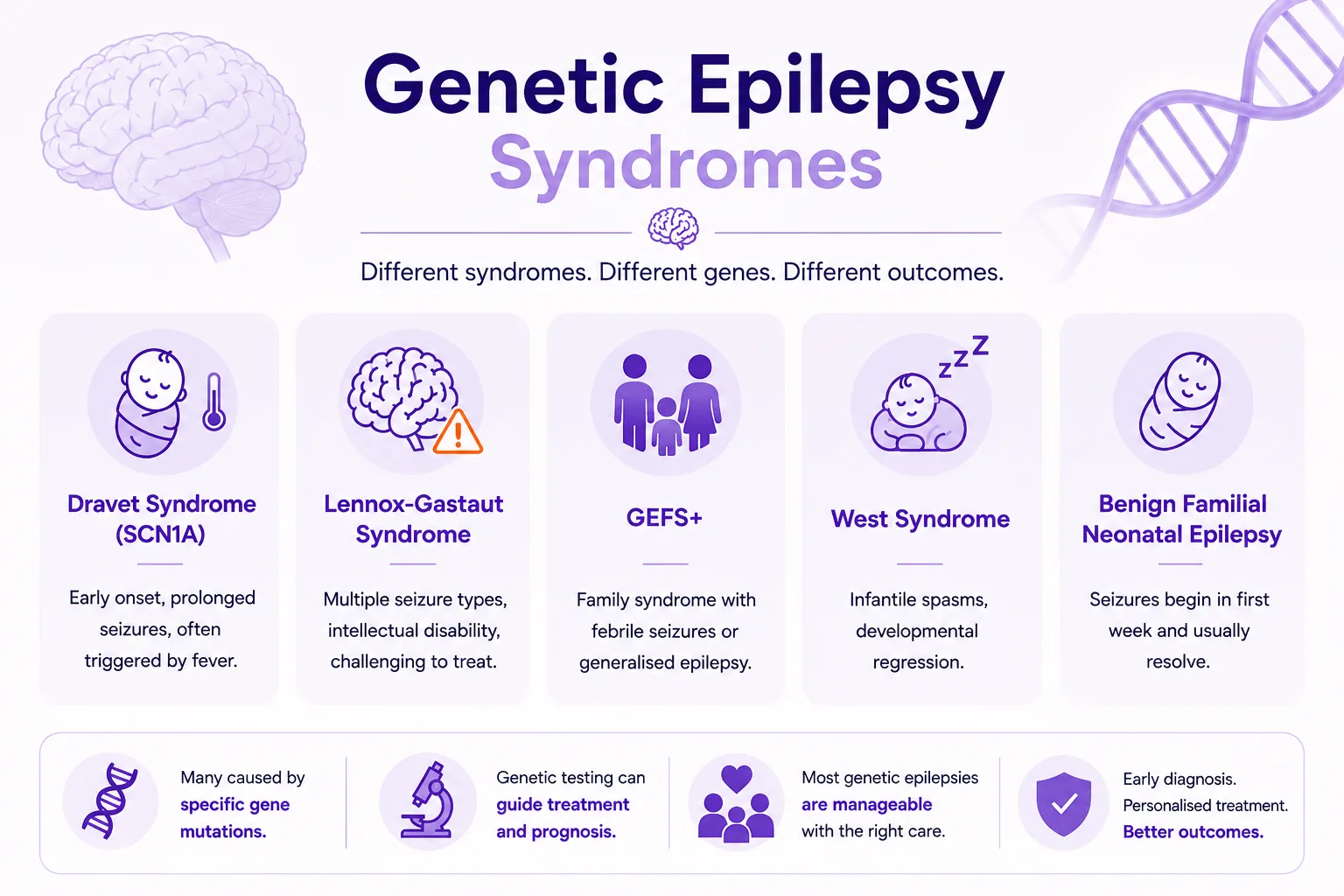
Genetic epilepsy types range from relatively mild to severe. Here are the most important ones to know about.
- Dravet Syndrome One of the most well-known genetic epilepsy types. It typically begins in the first year of life, often triggered by fever. Seizures are prolonged and frequent, and children often have developmental difficulties. The primary gene is SCN1A, and most cases are de novo.
- Lennox-Gastaut Syndrome A severe epilepsy syndrome with multiple seizure types, intellectual disability, and a characteristic EEG pattern. Unlike Dravet, Lennox-Gastaut syndrome is genetically heterogeneous – it can arise from many different causes, not one defining gene.
- GEFS+ (Generalised Epilepsy with Febrile Seizures Plus) A family syndrome where multiple members have febrile seizures or generalised epilepsy. Often linked to SCN1A or related genes. Usually milder than Dravet.
- West Syndrome Characterised by infantile spasms, a chaotic EEG pattern (hypsarrhythmia), and developmental regression. Can have genetic, structural, or metabolic causes.
- Benign Familial Neonatal Epilepsy Seizures begin in the first week of life and typically resolve on their own. Often caused by KCNQ2 mutations. As the name suggests, the outlook is generally good.
Genes + Environment: Why Not Everyone with the Gene Gets Epilepsy
Here’s something that surprises many families: having a gene variant associated with epilepsy does not guarantee you’ll develop epilepsy.
Two concepts explain this:
- Incomplete penetrance – Not everyone who carries a particular gene variant will actually develop the condition. The gene is there, but it doesn’t always “switch on.”
- Variable expressivity – Even within the same family, the same gene variant can cause very different outcomes. One sibling might have severe epilepsy; another might have only occasional febrile seizures; a third might be completely unaffected.
Environmental triggers also play a real role. In people who are genetically susceptible, certain factors can push the brain toward a seizure:
- Fever (especially significant in Dravet syndrome and GEFS+)
- Sleep deprivation
- Stress
- Certain medications that lower the seizure threshold
This is why epilepsy is best understood as an interaction between genetic predisposition and environmental factors – not a simple on/off switch.
Struggling with Seizures, Persistent Headaches, or Other Neurological Symptoms?
Should You Get Genetic Testing?
Genetic testing is not for everyone with epilepsy. But it’s worth serious consideration in certain situations.
When genetic testing is most likely to help:
- Epilepsy that began in infancy or early childhood
- Seizures that don’t respond to medication (drug-resistant epilepsy)
- A strong family history of epilepsy or febrile seizures
- Epilepsy accompanied by developmental delay or intellectual disability
- When you’re planning a pregnancy and want to understand the risk
What does testing involve? A blood sample is usually all that’s needed. The most comprehensive approach is a whole exome sequencing or epilepsy gene panel, which looks at hundreds of known epilepsy genes at once. Results can take several weeks.
What can it tell you?
- The specific cause of epilepsy (which can change treatment decisions)
- Whether the variant is inherited or de novo
- The risk for other family members or future children
- Whether a specific gene-targeted therapy might be relevant
It’s important to go into testing with realistic expectations. Not every test comes back with a clear answer – genetic science in epilepsy is still evolving.
What If Epilepsy Runs in Your Family? – Practical Steps
Finding out that epilepsy has a genetic component in your family can feel overwhelming. But there are concrete, helpful steps you can take.
1. Seek genetic counselling. A genetic counsellor can interpret test results, calculate personalised risk estimates for your family, and help you think through decisions around family planning. This is especially valuable if a specific gene variant has been identified.
2. Get an accurate diagnosis early. The earlier a genetic epilepsy is identified, the sooner the right treatment can begin. Some genetic epilepsies respond poorly to certain medications that work well for other types – knowing the cause prevents harmful trial-and-error.
3. Know that most genetic epilepsies are manageable. The majority of people with genetic epilepsy achieve good seizure control with the right anti-seizure medication. For those who don’t – the roughly 30% with drug-resistant epilepsy – advanced options exist.
4. Explore epilepsy surgery if medications aren’t working. Drug-resistant epilepsy is not a dead end. Advanced epilepsy surgery, including techniques like robotic Stereo-EEG mapping, laser interstitial thermal therapy (LITT), and neuromodulation (VNS, DBS), can offer meaningful seizure control even in complex genetic cases.
5. Don’t carry this alone. Epilepsy affects the whole family – not just the person having seizures. Support groups, patient advocacy organisations, and open conversations with your medical team all matter. You are not alone in this journey.
For families in the Delhi NCR region, Dr. Satyakam Baruah at Amrita Hospital, Faridabad is a specialist in exactly this area. With an M.Ch. in Neurosurgery from NIMHANS and an Epilepsy Surgery Fellowship from the Montreal Neurological Institute (2018–2019), he has treated over 2,000 epilepsy patients and performed more than 5,000 neurosurgical procedures. As a neurosurgeon in Faridabad who leads the Comprehensive Epilepsy Surgery programme, he works with patients who have drug-resistant epilepsy – including those with genetic epilepsy syndromes – using the most advanced tools available in India today
If you’re looking for an epilepsy specialist in Faridabad or seeking epilepsy treatment in Faridabad for yourself or a family member, a consultation with a specialist who understands both the genetic and surgical dimensions of epilepsy can make a real difference. Amrita Hospital Faridabad is a NABH-accredited tertiary care centre with dedicated neuro-ICU, advanced neuroimaging, and a multidisciplinary epilepsy team.

 WhatsApp