Movement Disorder Treatment in Faridabad
Movement disorder treatment in Faridabad under Dr. Satyakam Baruah, Senior Consultant Neurosurgeon, offers advanced options including Deep Brain Stimulation, thalamotomy, LITT, and Focused Ultrasound for conditions such as Parkinson’s disease, essential tremor, and dystonia. Movement disorders are neurological conditions caused by dysfunction in the brain’s movement-control centres, not muscles or bones and include conditions such as Parkinson’s disease, essential tremor, dystonia, and Huntington’s disease. Symptoms range from resting tremors and muscle rigidity to involuntary jerking, balance loss, and speech changes.
Early Diagnosis Saves Lives - Book an Appointment Today with Dr Satyakam Baruah!
What Are Movement Disorders?
Movement disorders are a group of brain conditions that affect how a person moves. They can cause too much movement – like shaking or jerking – or too little movement, like stiffness or slowness. These problems happen because certain parts of the brain that control movement stop working properly.
Movement disorders are not the same as muscle problems or bone problems. The issue starts in the brain, specifically in areas like the basal ganglia and cerebellum, which act like the body’s movement control centre. When these areas are damaged or don’t work right, the signals sent to the muscles become incorrect.
This guide covers movement disorders in adults, their types, symptoms, how they are diagnosed, and the treatment options available in Faridabad. It does not cover movement problems caused by stroke, spinal cord injury, or cerebral palsy, which are treated separately.
If you or a family member is dealing with shaking hands, stiff muscles, slow movements, or involuntary body jerks, this page will help you understand what may be happening and what you can do about it.
Common Types of Movement Disorders
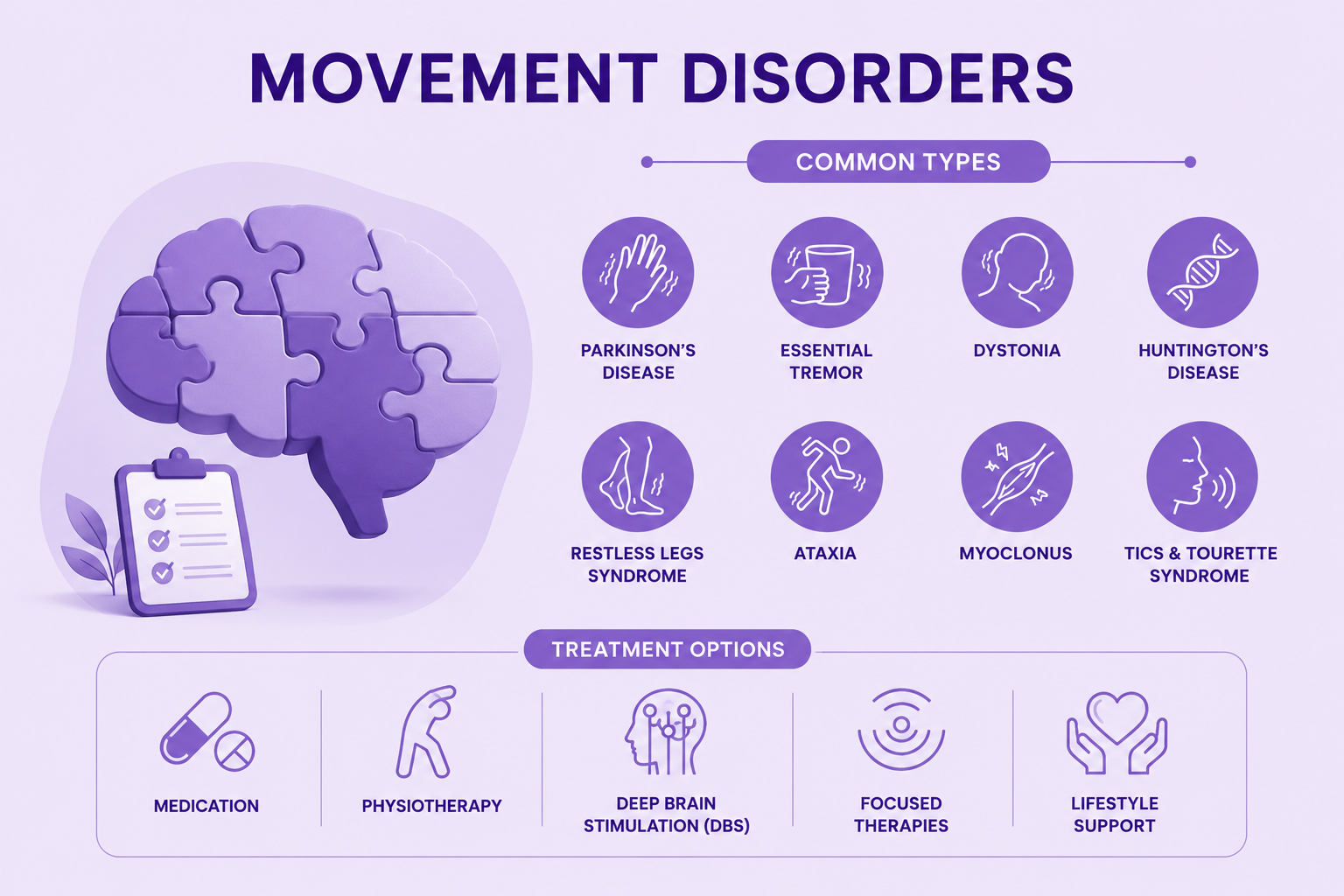
There are several types of movement disorders. Each one has different symptoms and needs a different treatment approach.
- Parkinson’s Disease is the most well-known movement disorder. It causes slowness of movement, stiffness, tremor (shaking at rest), and balance problems. It happens when the brain cells that make a chemical called dopamine start dying. About 10 million people worldwide live with Parkinson’s disease, according to the Parkinson’s Foundation.
- Essential Tremor is the most common movement disorder overall. It causes shaking in the hands, head, or voice, usually when a person is doing something – like holding a cup or writing. Unlike Parkinson’s, the shaking in essential tremor happens during movement, not at rest.
- Dystonia causes muscles to contract (tighten) without the person wanting them to. This can make the body twist into uncomfortable positions. It can affect one body part (like the neck or hand) or the whole body.
- Huntington’s Disease is a genetic condition that causes jerky, uncontrolled movements called chorea, along with thinking problems and mood changes. It is caused by a faulty gene that a person inherits from a parent.
- Restless Legs Syndrome (RLS) causes an uncomfortable urge to move the legs, especially at night. It often disturbs sleep and can greatly reduce quality of life.
- Ataxia causes problems with balance and coordination. People with ataxia may walk unsteadily or have trouble with fine hand movements like buttoning a shirt.
- Myoclonus causes sudden, brief muscle jerks or twitches. These can be mild or severe enough to affect daily tasks.
- Tics and Tourette Syndrome cause sudden, repetitive movements or sounds that are hard to control. Tourette syndrome involves both motor tics and vocal tics.
What Causes Movement Disorders?
Movement disorders have different causes depending on the type. Some are caused by genetics, some by damage to the brain, and others have no clear cause.
- Genetic causes – Conditions like Huntington’s disease and some types of dystonia are passed down in families. A gene test can confirm if someone carries the faulty gene.
- Dopamine imbalance – In Parkinson’s disease, brain cells that produce dopamine (a chemical that helps control smooth movement) are slowly destroyed. Without enough dopamine, movement becomes slow and stiff.
- Brain injury or infection – A head injury, brain infection, or lack of oxygen to the brain can sometimes damage movement-control areas and lead to a movement disorder.
- Medications – Some medicines, especially those used for mental health conditions, can cause abnormal movements as a side effect. This is called drug-induced movement disorder and may go away when the medicine is stopped or changed.
- Aging – As people get older, brain cells naturally slow down. This can sometimes lead to movement problems, though not all older adults develop movement disorders.
- Unknown causes – In many cases, especially with essential tremor, doctors are not always sure why the condition develops. Research is still ongoing.
Symptoms of Movement Disorder
Symptoms vary depending on the type of movement disorder. However, some warning signs are common across several conditions:
- Shaking or trembling in the hands, arms, legs, or head
- Stiff or rigid muscles that feel tight and hard to move
- Slowness in starting or completing movements
- Loss of balance or frequent falls
- Uncontrolled jerking or twisting of the body
- Difficulty writing, buttoning clothes, or holding objects
- Shuffling walk or difficulty turning while walking
- Involuntary blinking, grimacing, or facial movements
- Voice changes – shaky, soft, or slurred speech
- Sleep problems due to leg discomfort or body movements at night
These symptoms can start slowly and worsen over months or years. Many people wait too long before seeing a doctor because they think the symptoms are just a normal part of aging. Getting checked early by an expert neurosurgeon like Dr. Satyakam Baruah can make a big difference in how well the condition is managed.
How Are Movement Disorders Diagnosed?
Diagnosing a movement disorder takes a careful approach. There is no single test that works for all types. Dr. Satyakam Baruah, Senior Consultant Neurosurgeon at Amrita Hospital, Faridabad, uses a combination of clinical examination and advanced tests to reach an accurate diagnosis.
- Neurological examination – The doctor watches how the patient walks, holds their hands, and performs simple tasks. They check muscle tone, reflexes, and balance. This hands-on exam gives important clues about what part of the brain may be affected.
- MRI of the brain – A Magnetic Resonance Imaging (MRI) scan gives detailed pictures of the brain. It helps identify any structural problems, damage, or shrinkage in specific brain areas.
- DaTscan (Dopamine Transporter Scan) – This is a special brain scan that shows how much dopamine activity is present. It is very useful in confirming Parkinson’s disease and separating it from other conditions that look similar.
- Blood tests – These are done to check for treatable causes like thyroid problems, liver disease, or Wilson’s disease (a condition where copper builds up in the body and can cause movement problems).
- Genetic testing – If a hereditary condition like Huntington’s disease is suspected, a blood test can check for the faulty gene.
- Electromyography (EMG) – This test measures the electrical activity of muscles. It helps tell the difference between movement disorders and nerve or muscle diseases.
Getting the right diagnosis is the most important first step. Two people may have similar shaking, but one may have Parkinson’s while the other has essential tremor. The treatment is very different, so an accurate diagnosis is critical.
Movement Disorder Treatment Options in Faridabad
Treatment depends on the type of movement disorder, how severe it is, and the patient’s overall health. Dr. Satyakam Baruah is an expert neurosurgeon in Faridabad who offers a full range of treatment options – from medicines to advanced surgical procedures.
Medicines (Non-Surgical Treatment)
For many patients, especially those in the early stages, medicines can control symptoms well.
- Levodopa and Carbidopa – These are the most effective medicines for Parkinson’s disease. Levodopa turns into dopamine in the brain, helping to restore normal movement. Most patients see major improvement with this treatment.
- Dopamine Agonists – These medicines mimic the action of dopamine. They are sometimes used alone or alongside Levodopa.
- Beta-blockers – Medicines like Propranolol are commonly used to reduce tremor in essential tremor.
- Botulinum Toxin (Botox) Injections – For dystonia or certain tremors, small injections of Botox into overactive muscles can reduce unwanted contractions. The effect lasts 3 to 4 months, after which the injection is repeated.
- Anticholinergic medicines – These help with tremor and stiffness in some Parkinson’s patients, especially younger ones.
Surgical Treatment for Movement Disorders in Faridabad
When medicines no longer work well enough, or when side effects from medicines become a problem, surgery can offer excellent results.
Deep Brain Stimulation (DBS)
Deep Brain Stimulation is one of the most advanced treatments for movement disorders. It involves placing tiny electrodes (thin wires) deep inside specific parts of the brain. These electrodes are connected to a small device placed under the skin near the collarbone. The device sends gentle electrical pulses to the brain to correct abnormal signals.
DBS is approved for Parkinson’s disease, essential tremor, and dystonia. Studies show that DBS can reduce tremor by 60 to 90% in carefully selected patients. It does not cure the underlying disease, but it can dramatically improve quality of life – patients can often reduce their medicines or stop taking some of them.
Dr. Satyakam Baruah performs DBS procedures at Amrita Hospital, Faridabad, using advanced neuronavigation and brain mapping technology to place the electrodes with high precision.
Thalamotomy and Pallidotomy
These are older but still effective surgical procedures where a very small, controlled area of the brain is destroyed to stop abnormal signals.
- Thalamotomy targets a part of the brain called the thalamus. It is very effective for tremor, especially essential tremor.
- Pallidotomy targets a part called the globus pallidus. It helps with stiffness, slowness, and involuntary movements in Parkinson’s disease.
These procedures give permanent results without needing a device. Dr. Baruah performs these using stereotactic techniques – a highly precise method that uses a three-dimensional coordinate system to reach the exact target in the brain.
Laser Interstitial Thermal Therapy (LITT)
LITT is a minimally invasive procedure where a thin laser probe is placed into the brain through a small hole in the skull. The laser heats and destroys a precisely targeted brain area that is causing the problem. It is guided by real-time MRI imaging so the doctor can see exactly what is being treated.
LITT has a shorter recovery time compared to open brain surgery and is a good option for patients who are not good candidates for traditional surgery.
Focused Ultrasound
This is a non-invasive technique where high-frequency sound waves are focused on a specific brain target to destroy the overactive area. It requires no cuts and no anaesthesia. It is currently most effective for essential tremor and one side of the body in Parkinson’s patients.
Struggling with Seizures, Persistent Headaches, or Other Neurological Symptoms?
What Happens During Recovery ?
Recovery depends on the type of treatment. Patients on medicines may not need any recovery time, but regular follow-up visits are important to adjust the dose as the condition changes.
After DBS surgery, patients typically stay in hospital for 2 to 3 days. The device is switched on and programmed about 2 to 4 weeks after surgery. Programming continues over several visits as the settings are fine-tuned to give the best results. Most patients notice improvement within weeks of getting the device programmed.
For thalamotomy or pallidotomy, the hospital stay is usually 3 to 5 days. Patients can usually return to light activities within 2 to 3 weeks. Full recovery may take 4 to 6 weeks.
LITT patients may be able to go home the next day after the procedure, making it one of the fastest-recovery surgical options available.
Who Is a Good Candidate for Surgery for Movement Disorders ?
Not every patient needs surgery, and not every patient who needs surgery is suitable for all procedures. The following factors are considered:
- Medicines are no longer controlling symptoms well enough
- Side effects from medicines are causing significant problems (like uncontrolled extra movements called dyskinesias)
- The patient is in good general health
- There is no severe memory or thinking problem (for most DBS patients)
- The tremor or movement problem is affecting the patient’s ability to work, eat, or live independently
Dr. Satyakam Baruah carefully evaluates each patient before recommending surgery. A team approach is used – including neurologists, neurosurgeons, and neuropsychologists – to make sure surgery is the right choice and the expected benefit is clear.
Why Choose Dr. Satyakam Baruah for Movement Disorder Treatment in Faridabad?
Dr. Satyakam Baruah is a Senior Consultant Neurosurgeon and Assistant Professor of Neurosurgery at Amrita Hospital, Faridabad, with over 20 years of medical experience and more than a decade focused exclusively on neurosurgery. He has performed over 5,000 neurosurgical procedures and has trained at NIMHANS, Bangalore – one of India’s top neuroscience centres – and at the Montreal Neurological Institute, McGill University, Canada, where he completed a Clinical Fellowship in Epilepsy and Functional Neurosurgery.
His expertise includes:
- Deep Brain Stimulation (DBS) for Parkinson’s disease, tremor, and dystonia
- Thalamotomy and pallidotomy for movement disorders
- Laser Interstitial Thermal Therapy (LITT)
- Neuronavigation and intraoperative brain mapping for precision surgery
- Comprehensive pre-surgical evaluation and post-surgical programming
Patients travel from across Delhi NCR – including Gurgaon, Noida, South Delhi, Rohtak, and Palwal – as well as from other states and even from abroad, to seek his care.
When Should You See a Doctor for Movement Disorder?
Do not wait until symptoms become severe. See a neurologist or neurosurgeon if:
- You notice shaking in your hands, legs, or head that does not go away
- A family member points out that your movements look unusual
- You feel unusually stiff or slow in your daily movements
- You have fallen more than once without a clear reason
- Your handwriting has become very small or your voice has become very soft
- Your current medicines are not helping as much as they used to
Early evaluation means more treatment options and better results.
Book an Appointment
If you or someone in your family is dealing with tremors, stiffness, involuntary movements, or any other movement-related symptoms, Dr. Satyakam Baruah is available for consultation in Faridabad.
To book your appointment, visit beyondseizures.com/book-appointment or call the clinic directly.
This page is for informational purposes only and is not a substitute for professional medical advice, diagnosis, or treatment. Always consult a qualified neurosurgeon or neurologist for any medical concerns related to movement disorders.

Dr. Satyakam Baruah’s Medical Content Team
Dr. Satyakam Baruah’s medical content team specialises in creating accurate, clear, and patient-focused healthcare content. With strong clinical understanding and expertise in technical writing and SEO, the team translates complex medical information into reliable, accessible resources that support informed decisions and uphold Dr. Satyakam's commitment to quality care.
This content is reviewed by Dr. Satyakam Baruah
 WhatsApp