Epilepsy Treatment in Faridabad
Epilepsy is a manageable neurological condition. Whether you’re newly diagnosed or living with drug-resistant seizures that haven’t responded to multiple medications, expert care is available in Faridabad. Dr. Satyakam Baruah – fellowship-trained at the Montreal Neurological Institute, Canada – offers advanced diagnostics, anti-epileptic medications, dietary therapy, minimally invasive surgery, laser thermal ablation (LITT), and neuromodulation at Amrita Hospital, Mata Amritanandamayi Marg, RPS City, Sector 88, Faridabad, Haryana 121014.
Early Diagnosis Saves Lives - Book an Appointment Today with Dr Satyakam Baruah!
What Is Epilepsy?
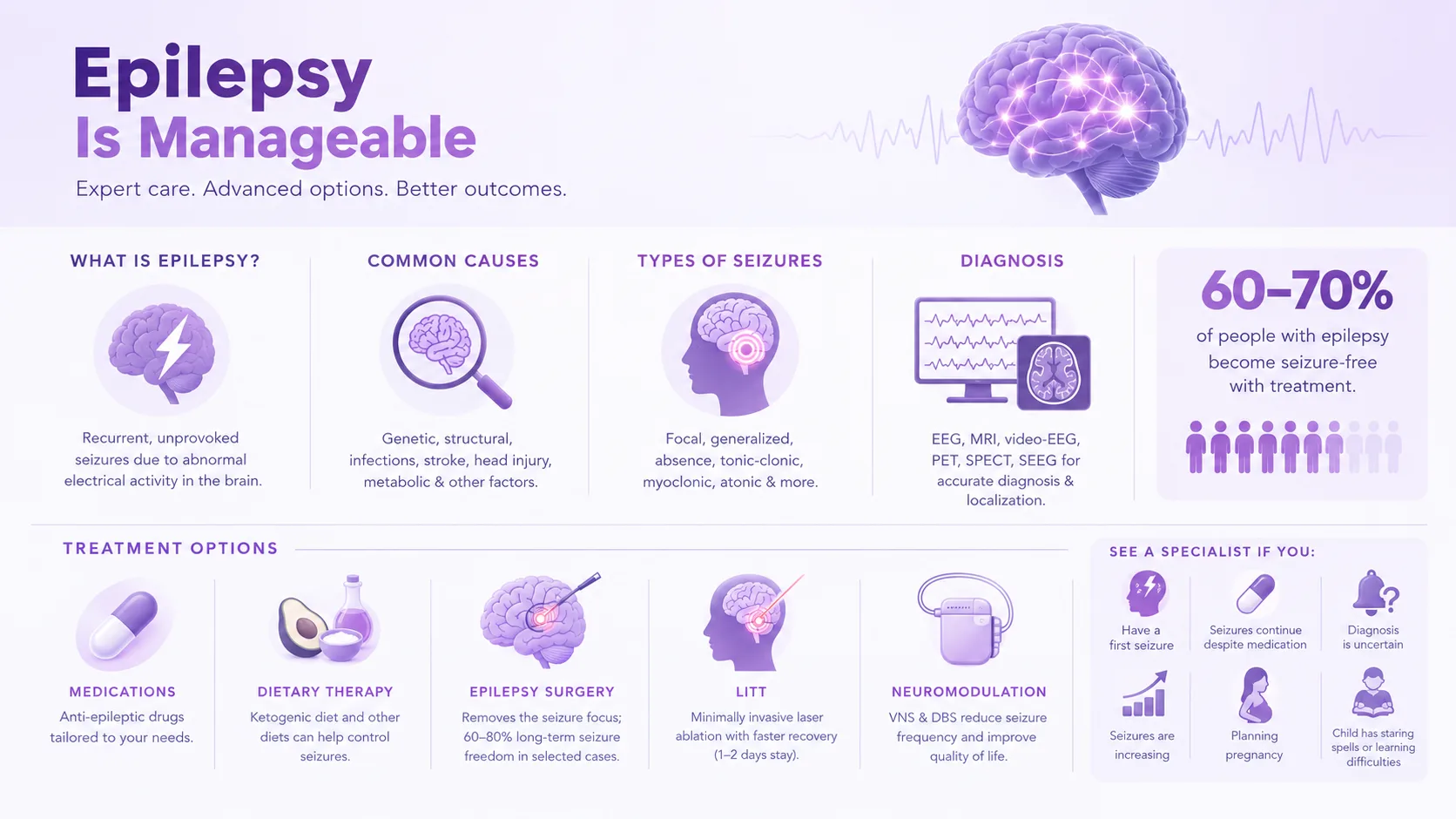
Epilepsy is a neurological disorder defined by recurrent, unprovoked seizures – seizures that occur without a clear temporary trigger like fever or low blood sugar.
One seizure is not epilepsy. Up to 10% of people will have a single seizure in their lifetime. Epilepsy is diagnosed when a person has two or more unprovoked seizures at least 24 hours apart, or when a single seizure is accompanied by a high probability of recurrence based on EEG or brain imaging findings.
Epilepsy is not a mental illness. It originates from abnormal, excessive electrical discharges in the brain – a sudden electrical storm in an otherwise well-organised system. These discharges can alter awareness, movement, sensation, or behaviour for seconds to minutes at a time.
With the right treatment, 60–70% of people with epilepsy become seizure-free on medication alone. For those who don’t, surgery, LITT, and neuromodulation offer real hope.
Epilepsy Causes and Risk Factors
Identifying the underlying cause directly shapes the treatment plan. In roughly 50% of cases, no specific cause is found (idiopathic or genetic epilepsies). In the other half, a root cause can be identified with modern diagnostics.
Genetic Causes
Some epilepsies are inherited; others arise from de novo mutations – spontaneous genetic changes with no family history. These mutations often affect ion channels, disrupting how neurons communicate. Dravet syndrome (SCN1A gene mutation) and juvenile myoclonic epilepsy have well-characterised genetic bases. Genetic testing is now routine for children and young adults with unexplained epilepsy.
Structural and Acquired Causes
Structural epilepsy means a detectable abnormality in the brain’s architecture is causing seizures. Common causes include:
- Head trauma – road accidents and falls are a leading cause in young Indian adults
- Stroke – the most common cause of new-onset epilepsy in adults over 35
- Brain tumours – both benign and malignant tumours can irritate surrounding tissue
- Mesial temporal sclerosis (MTS) – scarring in the inner temporal lobe; the most frequent cause of drug-resistant focal epilepsy and one of the most surgically treatable
- Cortical dysplasia – abnormal brain development during foetal life, often invisible on standard MRI
Infectious and Immune Causes
In India, neurocysticercosis – a parasitic infection from the tapeworm Taenia solium – is one of the most common acquired causes of epilepsy. Bacterial meningitis, viral encephalitis, and tubercular meningitis can all leave scarred brain tissue that triggers future seizures.
Autoimmune epilepsies – such as anti-NMDA receptor encephalitis or LGI1 antibody encephalitis – are increasingly recognised and require immunotherapy alongside anti-seizure medications.
Metabolic and Developmental Causes
Metabolic disorders can trigger seizures, especially in newborns. Pyridoxine-dependent epilepsy and GLUT1 deficiency syndrome are examples where dietary intervention is specifically curative. Epilepsy also co-occurs frequently with autism spectrum disorder (ASD) and cerebral palsy.
Common Causes by Age Group
| Age Group | Most Common Causes |
| Newborns (0–1 month) | Birth hypoxia, brain malformations, electrolyte imbalances |
| Infants & young children | Genetic syndromes, febrile seizures, infections |
| School-age children | Idiopathic/genetic epilepsies, cortical dysplasia, CECTS |
| Adults (18–35) | Head trauma, cortical dysplasia, idiopathic |
| Adults (35+) | Stroke, brain tumours, mesial temporal sclerosis |
| Elderly (60+) | Stroke, dementia, vascular disease |
Epilepsy Symptoms and Signs
Seizures look very different depending on which part of the brain is affected. Many families miss early seizures because they don’t look like the dramatic shaking seen in films.
General Symptoms
- Motor symptoms: Rhythmic jerking (clonic), muscle stiffening (tonic), sudden limpness (atonic), or subtle twitching of one limb
- Awareness changes: Staring spells, confusion, or complete loss of consciousness
- Automatisms: Repetitive movements – lip-smacking, chewing, or fumbling with clothing
- Autonomic changes: Rapid heartbeat, altered breathing, skin flushing, loss of bladder control
- Sensory changes: Tingling, visual disturbances, unusual smells or tastes
A seizure typically lasts 30 seconds to 3 minutes. Anything beyond 5 minutes is a medical emergency.
Auras
Many people with focal seizures experience an aura – a brief, distinctive sensation before a seizure. Auras are not a warning before the seizure; they are the seizure, beginning in a small brain region. Common auras include a rising sensation in the stomach, sudden intense fear, déjà vu, visual flashes, or a strange smell. Recognising your aura gives you seconds to sit down safely.
Post-Seizure Symptoms
After a seizure, the brain needs recovery time. This post-ictal phase can involve deep fatigue, confusion, headache, or Todd’s paralysis – temporary weakness on one side of the body lasting up to several hours. Todd’s paralysis resolves on its own and is an important clinical clue about where the seizure originated.
Types of Epilepsy and Seizures
Seizure type determines which medications work, whether surgery is an option, and what the long-term outlook looks like.
Focal Seizures
Focal seizures begin in a specific network of neurons on one side of the brain and are the most common type in adults. They may be focal aware (consciousness preserved) or focal impaired awareness (consciousness affected, with automatisms and no memory of the episode). They can spread to both hemispheres – called a focal to bilateral tonic-clonic seizure.
Lobe of origin matters: temporal lobe seizures involve auras and déjà vu; frontal lobe seizures are often nocturnal with bizarre posturing; occipital lobe seizures cause visual hallucinations.
Generalised Seizures
Generalised seizures involve both hemispheres from the outset:
- Absence seizures: Brief staring spells of 5–15 seconds; common in children aged 4–12; often mistaken for daydreaming
- Tonic-clonic seizures: Sudden loss of consciousness, body stiffening, then rhythmic jerking – the most well-known type
- Atonic seizures (drop attacks): Sudden loss of muscle tone causing collapse – a significant injury risk
- Myoclonic seizures: Brief, shock-like muscle jerks, usually in the arms and shoulders, often in the morning
Drug-Resistant Epilepsy
Drug-resistant epilepsy (DRE) is defined by the ILAE as the failure of two appropriately chosen and tolerated anti-seizure medications to achieve sustained seizure freedom. It affects approximately 30% of people with epilepsy. This is not a failure of the patient – it reflects the biology of certain epilepsies. DRE requires a comprehensive presurgical evaluation including SEEG, PET, and SPECT to locate the seizure focus.
Rare Epilepsy Syndromes
- Lennox-Gastaut Syndrome (LGS): Multiple seizure types, intellectual disability, very difficult to treat
- Dravet Syndrome: Severe, treatment-resistant epilepsy from infancy; SCN1A mutation; sodium channel blockers like carbamazepine are contraindicated
- Childhood Epilepsy with Centrotemporal Spikes (CECTS): Common, benign; almost always resolves by mid-adolescence
- West Syndrome (Infantile Spasms): Clusters of sudden body flexions in infants; requires urgent ACTH or vigabatrin to prevent developmental regression
How Is Epilepsy Diagnosed?
Epilepsy is diagnosed using EEG, MRI, and video-EEG monitoring – with advanced tools added for complex cases.
- Clinical history comes first: what the seizure looked like, how long it lasted, what happened before and after, plus family history and any head injuries. A witness account from a family member is invaluable.
- EEG records the brain’s electrical activity and can detect abnormal discharge patterns even between seizures. If a routine EEG is normal but seizures continue, we move to video-EEG monitoring – the gold standard for seizure classification – where continuous EEG is recorded alongside video for 3–7 days.
- MRI brain (epilepsy protocol) uses specific sequences (3T magnet, thin-slice FLAIR, volumetric T1) to detect subtle lesions – like cortical dysplasia – that a routine scan misses entirely.
- FDG-PET measures glucose metabolism; the epileptogenic zone typically shows hypometabolism between seizures. Ictal SPECT / SISCOM shows which brain region had a blood-flow surge during a seizure, overlaid onto the MRI for precise localisation.
- SEEG (Stereoelectroencephalography) places thin electrodes directly into the brain through small drill holes – no open craniotomy – to record seizure activity from deep structures with pinpoint accuracy. SEEG is a key tool for drug-resistant and MRI-negative epilepsy cases in Faridabad and across Delhi NCR.
Epilepsy Treatment Options in Faridabad
Treatment is always personalised, starting with the least invasive option and escalating thoughtfully when needed.
Medications (Anti-Epileptic Drugs)
Medications are the first line of treatment for virtually all patients. Commonly used drugs include:
- Levetiracetam: Broad-spectrum, well-tolerated; widely used first-line for focal and generalised seizures
- Valproate (sodium valproate): Highly effective for generalised epilepsies including LGS and JME; requires monitoring in women of childbearing age
- Lamotrigine: Excellent for focal seizures and absence epilepsy; requires slow dose titration
- Carbamazepine / Oxcarbazepine: First-choice for temporal lobe epilepsy; avoid in Dravet syndrome
- Lacosamide, Perampanel, Brivaracetam: Newer agents for drug-resistant focal epilepsy
The right drug depends on seizure type, epilepsy syndrome, age, gender, and tolerability. Medication adherence is everything – missing doses is the most common cause of breakthrough seizures. If two medications fail, we formally evaluate for drug-resistant epilepsy.
Dietary Therapy (Ketogenic Diet)
The ketogenic diet – high-fat, very low-carbohydrate – shifts the brain’s fuel source from glucose to ketone bodies, with a well-established anti-seizure effect. It is most effective in children with drug-resistant epilepsy, and specifically indicated in GLUT1 deficiency and Dravet syndrome. Modified versions (modified Atkins diet, low glycaemic index treatment) are used in older children and adults. Dietary therapy requires close supervision by an experienced dietitian with regular blood and urine monitoring.
Epilepsy Surgery
Surgery is the most effective treatment for drug-resistant focal epilepsy where a clear seizure onset zone can be safely removed. In well-selected patients, 60–80% achieve long-term seizure freedom – a result no medication can match for this group.
Procedures include:
- Temporal lobectomy / selective amygdalohippocampectomy (SAH): Removal of seizure-generating tissue in the temporal lobe; seizure freedom rates of 60–80% at 2 years
- Lesionectomy: Precise removal of a structural lesion (tumour, cavernoma, cortical dysplasia)
- Corpus callosotomy: Cuts the connection between hemispheres to prevent seizure spread; used mainly for drop attacks in LGS
- Hemispherotomy: Disconnection of one hemisphere; used in severe unilateral epilepsies in children
Surgery is not a last resort. If two medications have failed, a surgical evaluation is warranted.
Laser Thermal Ablation (LITT)
Laser Interstitial Thermal Therapy (LITT) is a minimally invasive alternative to open surgery. A thin laser probe is guided into the seizure-generating tissue through a small drill hole. Real-time MRI thermometry monitors the heat as the laser destroys the target with precision.
LITT advantages over open surgery: no large craniotomy, hospital stay of 1–2 days (vs. 5–7 for open surgery), faster recovery, lower infection risk. LITT is best suited for mesial temporal sclerosis (hippocampal ablation), hypothalamic hamartomas, and small deep-seated lesions.
Neuromodulation (VNS and DBS)
For patients who cannot have resective surgery, neuromodulation offers meaningful seizure reduction.
- Vagus Nerve Stimulation (VNS): A small pulse generator implanted under the chest skin sends regular electrical pulses to the brain via the left vagus nerve. VNS reduces seizure frequency by 50% or more in many patients and includes a magnet-swipe feature to abort a seizure during an aura.
- Deep Brain Stimulation (DBS): Electrodes placed into the anterior nucleus of the thalamus are connected to a chest pulse generator. Approved for drug-resistant focal epilepsy, DBS has shown sustained seizure reduction in long-term studies.
Both are palliative – they reduce seizure burden rather than eliminate seizures entirely – but for the right candidate, the quality-of-life improvement is transformative.
Struggling with Seizures, Persistent Headaches, or Other Neurological Symptoms?
Epilepsy Treatment Cost in Faridabad
Epilepsy treatment cost in Faridabad varies based on the type of treatment, diagnostic workup, and procedure complexity. Medication-based management is the most affordable long-term option. A straightforward case may need only an EEG and MRI. A complex drug-resistant case may require video-EEG monitoring, PET, SPECT, and SEEG – each adding to the evaluation cost. Neuromodulation devices (VNS, DBS) carry a significant device cost component.
At Amrita Hospital, Sector 88, Faridabad, you receive internationally trained specialist care – Dr. Baruah’s fellowship is from the Montreal Neurological Institute, one of the world’s leading epilepsy centres – without the overhead markups of large Delhi NCR hospital chains. We provide transparent cost estimates before any procedure and plan treatment in stages where possible. International patients receive upfront estimates before travel.
When Should You See an Epilepsy Specialist?
See an epilepsy specialist promptly if any of the following apply:
- ✅ You’ve had a first seizure – a specialist evaluation is essential to assess recurrence risk
- ✅ Seizures continue despite medication – this is drug-resistant epilepsy and requires re-evaluation
- ✅ Your diagnosis is uncertain – not every blackout or episode is epilepsy
- ✅ Seizures are increasing in frequency or severity
- ✅ Medication side effects are affecting daily life – there are many AED options; you shouldn’t have to live with intolerable side effects
- ✅ You’re a woman with epilepsy planning a pregnancy – AED management in pregnancy requires specialist input
- ✅ A child has staring spells, behavioural changes, or unexplained learning difficulties – these can be subtle seizure presentations
- ✅ You’ve been told surgery isn’t possible – advances in SEEG and LITT mean some previously deemed inoperable patients now have surgical options
Complications and Prevention
Status Epilepticus
Status epilepticus is a seizure lasting longer than 5 minutes, or two or more seizures without full recovery between them. It is a medical emergency – call 112 immediately. If a rescue medication like rectal diazepam or buccal midazolam has been prescribed, administer it while waiting for help. Prolonged seizure activity can cause permanent neurological injury or death without immediate treatment.
SUDEP
Sudden Unexpected Death in Epilepsy (SUDEP) occurs in approximately 1 in 1,000 adults with epilepsy per year, with higher rates in those with frequent, uncontrolled tonic-clonic seizures. The mechanism likely involves seizure-related disruption of breathing and heart rhythm. SUDEP is rare in well-controlled epilepsy – a compelling reason to pursue effective seizure control. Practical steps: sleep on your side, use a seizure monitor at night, avoid sleeping alone when seizures are uncontrolled.
Prevention Tips
- Wear helmets and seatbelts – traumatic brain injury is a major preventable cause
- Control blood pressure and cardiovascular risk – reducing stroke risk reduces post-stroke epilepsy risk
- Vaccination and hygiene – preventing meningitis and neurocysticercosis
- Medication adherence – the single most important thing a person with epilepsy can do
- Regular sleep – sleep deprivation is one of the most reliable seizure triggers
- Limit alcohol – lowers the seizure threshold and interacts with AEDs
- Keep a seizure diary – tracking episodes and triggers helps your doctor optimise treatment
Why Choose Dr. Satyakam Baruah for Epilepsy Treatment in Faridabad?
- Fellowship training from the Montreal Neurological Institute (MNI), Canada. The MNI is one of the world’s foremost epilepsy centres – the institution where the modern understanding of the epileptogenic zone was largely developed. Dr. Baruah’s training included hands-on SEEG, presurgical evaluation, resective surgery, LITT, and neuromodulation in a high-volume international centre.
- Subspecialty focus on drug-resistant epilepsy. Dr. Baruah’s practice is built around epilepsy – particularly the complex, treatment-resistant cases that other centres have struggled to help. If you’ve been told “nothing more can be done,” a second opinion is worth your time.
- Full spectrum of minimally invasive options. From SEEG for diagnostic localisation to LITT for minimally invasive ablation, to VNS and DBS implantation – the complete toolkit of modern epilepsy treatment, not just medications and referrals.
- MRI-negative epilepsy expertise. Cases where standard MRI is normal are among the most challenging in epilepsy. Advanced imaging protocols combined with SEEG capability mean we can often identify and treat seizure foci that other centres miss.
- Personalised, continuous care. The same specialist who reviews your EEG performs your surgery and follows you up long-term. Families consistently tell us this continuity makes an enormous difference to their confidence.
- Accessible location, affordable care. Dr. Baruah sees patients at Amrita Hospital, Mata Amritanandamayi Marg, RPS City, Sector 88, Faridabad, Haryana 121014 – accessible from across Faridabad and Delhi NCR. International patients from South Asia, the Middle East, and Africa receive full support including pre-arrival case review and tele-follow-up.
Book Your Appointment
If you or someone you love is living with seizures – whether newly diagnosed or years into a difficult journey with drug-resistant epilepsy – please don’t wait. Early specialist evaluation saves time, prevents unnecessary suffering, and opens doors to treatments that can dramatically change the outcome.
Dr. Satyakam Baruah sees patients at Amrita Hospital, Mata Amritanandamayi Marg, RPS City, Sector 88, Faridabad, Haryana 121014. Consultations are available in person and via tele-consultation for patients across Delhi NCR and internationally.
Fill in the contact form on this page or reach us via WhatsApp. We aim to respond within 24 hours and can usually offer an appointment within a few days for urgent cases.
Bring any previous EEG reports, MRI scans, and a list of medications tried – this helps us make the most of your first consultation.
Frequently Asked Questions
How much does epilepsy treatment cost in Faridabad? expand_more
Cost varies by treatment type. Medication management is the most affordable; surgery and neuromodulation involve higher upfront costs, including device costs for VNS and DBS. At Amrita Hospital, Sector 88, Faridabad, we provide transparent cost estimates before any procedure and offer internationally trained care at significantly lower cost than large Delhi NCR chains.
Can epilepsy be cured? expand_more
Yes, for some patients. Epilepsy surgery achieves long-term seizure freedom in 60–80% of well-selected candidates, particularly those with mesial temporal sclerosis. Some childhood syndromes like CECTS resolve spontaneously. For others, epilepsy is a lifelong but very effectively managed condition.
What is drug-resistant epilepsy? expand_more
Drug-resistant epilepsy is the failure of two appropriately chosen and tolerated anti-seizure medications to achieve sustained seizure freedom. It affects about 30% of people with epilepsy. The next step is a comprehensive evaluation for surgery, LITT, dietary therapy, or neuromodulation - not giving up.
Is epilepsy surgery safe? expand_more
In experienced hands with thorough presurgical planning, the risks are well-characterised and generally low. Temporal lobectomy carries a serious complication rate of less than 5% in specialised centres. For appropriate candidates, the risk of remaining on uncontrolled seizures - including SUDEP and progressive cognitive decline - often outweighs the surgical risk.
How many consultations does epilepsy treatment take? expand_more
A straightforward new diagnosis may need 2–3 consultations to establish the right medication. A drug-resistant epilepsy evaluation for surgery typically involves multiple visits - video-EEG monitoring, advanced imaging, neuropsychological testing - over 4–8 weeks. We give every patient a clear roadmap at the first consultation.
Can children with epilepsy live a normal life? expand_more
Yes. Most children - especially those with CECTS or childhood absence epilepsy - respond well to medication and lead completely normal lives, often coming off medication in adolescence. Even children with more complex epilepsies can attend school and participate in most activities with appropriate precautions.
What should I do if someone has a seizure? expand_more
Stay calm, time the seizure, and call 112 if it lasts more than 5 minutes. Gently lower the person to the floor, cushion their head, and turn them onto their side. Remove nearby hazards. Do not put anything in their mouth and do not restrain them. Stay with them until they are fully conscious and oriented.

Dr. Satyakam Baruah’s Medical Content Team
Dr. Satyakam Baruah’s medical content team specialises in creating accurate, clear, and patient-focused healthcare content. With strong clinical understanding and expertise in technical writing and SEO, the team translates complex medical information into reliable, accessible resources that support informed decisions and uphold Dr. Satyakam's commitment to quality care.
This content is reviewed by Dr. Satyakam Baruah
Related Conditions

Epileptic Spasms Treatment in Faridabad
Epileptic spasms are brief, clustered axial jerks lasting one to two seconds, most common in infants shortly after waking, and…
MRI Negative Epilepsy Treatment in Faridabad
MRI Negative Epilepsy Treatment in Faridabad by Dr. Satyakam Baruah offers advanced evaluation with Video EEG, PET, SPECT, SEEG, and…
Related Blogs
Is Epilepsy Hereditary?
In Summary – What You Need to Know Epilepsy is not always hereditary. About 30–40% of cases have…
Read Article →
When Seizures Don’t Stop: Drug Resistant Epilepsy
Drug resistant epilepsy is diagnosed when seizures continue despite trying at least two appropriate anti-seizure…
Read Article → WhatsApp