Tremor Treatment in Faridabad
A tremor is an uncontrolled, rhythmic shaking of one or more parts of the body. It most often affects the hands, but it can also happen in the arms, legs, head, voice, or even the trunk. Tremors are the most common movement disorder in the world. Research shows that essential tremor alone affects about 1 in 20 people over the age of 40, and nearly 1 in 5 people over the age of 65. Despite how common it is, many people go years without a proper diagnosis or treatment. Tremor Treatment in Faridabad under the care of Dr Satyakam Baruah, Senior Consultant Neurosurgeon, patients with tremor receive thorough evaluation, an accurate diagnosis, and access to the most advanced treatment options available in India, including Deep Brain Stimulation (DBS), Laser Interstitial Thermal Therapy (LITT), and neuromodulation therapies.
Early Diagnosis Saves Lives - Book an Appointment Today with Dr Satyakam Baruah!
What Is a Tremor?
A tremor is caused by problems in the brain regions that control movement. Normally, the brain sends smooth, coordinated signals to your muscles. When certain brain circuits are not functioning correctly, those signals become irregular, leading to involuntary shaking.
Not all shaking is a tremor, and not all tremors are the same. Some tremors occur at rest, while others only appear during movement. Some are mild and barely noticeable, while others make it difficult to hold a pen, drink from a glass, or button a shirt. Understanding which type of tremor a patient has is the first step toward effective treatment.
Tremors are not life-threatening on their own, but they can seriously reduce quality of life. They can interfere with work, self-care, and confidence, which is why timely consultation with a specialist matters.
Causes and Risk Factors of Tremor
Tremors can develop for many different reasons. In some cases, the cause is a specific brain condition. In others, factors like medication, lifestyle, or genetics play a role.
Neurological conditions are the most common cause. Parkinson’s disease causes a characteristic resting tremor, usually starting in one hand. Multiple sclerosis, stroke, and traumatic brain injury can damage the cerebellum or its connections, leading to a different type of tremor called intention tremor.
Genetics plays a strong role in essential tremor, the most common type of tremor. Studies show that about 50% of people with essential tremor have a close family member with the same condition. If a parent has essential tremor, each child has roughly a 50% chance of inheriting the tendency.
Other risk factors that can trigger or worsen tremors include:
- Certain medications, especially those used for asthma, mood disorders, or seizures
- Excessive caffeine or alcohol withdrawal
- Thyroid problems (an overactive thyroid speeds up the body’s processes, including muscle activity)
- Liver disease affects toxin clearance
- Anxiety or extreme fatigue, which can make existing tremors worse
- Advancing age, since the brain’s movement control systems naturally change over time
Important note: A tremor is not a sign of weakness or a mental health condition. It is a neurological symptom with clear biological causes and responds well to appropriate treatment.
Types of Tremor
Correctly identifying the type of tremor is critical because different types respond to completely different treatments.
1. Essential Tremor
Essential tremor is the most common movement disorder worldwide. It usually affects the hands and arms during movement, such as when reaching for something or writing. Unlike Parkinson’s tremor, it typically does not occur at rest. It can also affect the head, causing a “yes-yes” or “no-no” nodding motion, and sometimes the voice. Essential tremor often runs in families and worsens gradually over the years.
2. Parkinsonian Tremor
This type of tremor is associated with Parkinson’s disease and usually starts in one hand while it is resting in the lap or at the side. It is often described as a “pill-rolling” movement, as if the person is rolling a small object between their fingers. It typically improves when the hand is used for a task, the opposite of essential tremor.
3. Cerebellar (Intention) Tremor
This tremor is caused by damage to the cerebellum, the part of the brain that fine-tunes movement. It appears during intentional movements, such as reaching toward a target, and gets worse as the hand approaches the target. Causes include multiple sclerosis, stroke, or injuries to the cerebellum.
4. Orthostatic Tremor
This is a rare but distinctive tremor that affects the legs and trunk. It appears only when a person is standing and disappears immediately when they sit or walk. People with orthostatic tremor often feel extremely unsteady while standing, even though they look stable to an observer.
5. Dystonic Tremor
Dystonic tremor occurs alongside dystonia, a condition where muscles contract involuntarily into abnormal postures. This type of tremor is often irregular and may be relieved by touching the affected body part.
The accurate diagnosis and management of these tremor types require specialised neurological expertise, and clinicians like Dr Satyakam Baruah bring over two decades of experience in diagnosing and treating the full spectrum of tremor disorders with a patient-specific approach.
Tremor Symptoms and Early Warning Signs
Recognising a tremor early gives doctors more treatment options and helps patients manage the condition before it seriously limits daily life. Common symptoms include:
- Shaking or trembling in the hands, arms, head, or voice that comes and goes or is constant
- Difficulty with tasks that require fine motor control, such as writing, typing, or buttoning clothes
- Handwriting that becomes larger, smaller, or uneven
- A shaky or quivering voice when speaking
- Problems holding a cup, spoon, or fork without spilling
- Worsening of shaking under stress, fatigue, or after caffeine
- Leg trembling that makes standing feel unsafe
If any of these symptoms last for more than two weeks or begin to affect work or daily activities, it is important to see a neurologist or neurosurgeon like Dr Satyakam Baruah for a full evaluation. Early diagnosis leads to better outcomes and greater control over the condition.
Diagnosis and Medical Tests for Tremor Treatment in Faridabad
At Dr Satyakam Baruah’s Practice, the diagnostic process follows structured international neurology guidelines to find the exact cause and type of tremor before any treatment is recommended.
Common Diagnostic Tests
- Neurological Examination: The doctor observes the tremor at rest and during movement, checks muscle tone and reflexes, and asks detailed questions about when the tremor started, what makes it better or worse, and whether it runs in the family. This examination alone can identify the likely type of tremor in most patients.
- Blood Tests: Thyroid function, liver function, and blood chemistry tests help rule out metabolic causes of tremor, which are common and often missed.
- MRI Brain Scan: Magnetic Resonance Imaging provides detailed images of the brain and can detect structural abnormalities such as stroke, multiple sclerosis lesions, or cerebellar damage that may be causing the tremor.
- DaTSCAN (Dopamine Transporter Scan): This specialised nuclear imaging test measures dopamine-producing cells in the brain. It is particularly useful for distinguishing Parkinson’s disease from essential tremor, which is one of the most common diagnostic challenges in tremor management.
- Electromyography (EMG): This test measures muscle electrical activity and tremor frequency. It helps classify the tremor type precisely and guides treatment planning, especially when surgery is being considered.
Every patient at Dr Satyakam Baruah’s clinic receives a clear explanation of what each test showed and what the results mean for their specific situation.
Treatment Options for Tremor
Treatment for tremor depends entirely on its type, severity, the patient’s age, and the impact on daily life. If you’re looking for the best treatment options for tremors in Faridabad, Dr Satyakam Baruah and his team build a personalised plan for every patient using evidence-based approaches.
1. Medications for Tremor
Medications are usually the first step. For essential tremor, beta-blockers such as propranolol and the anti-seizure drug primidone have strong evidence for reducing tremor severity, with about 50 to 75% of patients experiencing meaningful improvement. For Parkinsonian tremor, levodopa and dopamine agonists target the underlying loss of dopamine-producing cells. For dystonic tremor, botulinum toxin injections into specific muscles can provide targeted relief lasting 3 to 4 months per session.
2. Deep Brain Stimulation (DBS)
Deep Brain Stimulation is one of the most effective treatments available for severe or medication-resistant tremor. In this procedure, Dr. Baruah places tiny electrodes into specific regions of the brain, most often the thalamus (for essential tremor) or the subthalamic nucleus (for Parkinson’s). These electrodes connect to a small device implanted under the skin of the chest, similar to a pacemaker. The device sends controlled electrical pulses that interrupt the abnormal brain signals causing the tremor. Clinical studies show that DBS reduces tremor severity by 80 to 90% in carefully selected patients with essential tremor. The device settings can be adjusted non-invasively after surgery as the patient’s needs change.
3. Focused Ultrasound (FUS) Thalamotomy
This is a non-invasive procedure that uses high-intensity ultrasound beams, guided by MRI, to create a small, precise lesion in the thalamus. No incision or implanted device is required. Focused Ultrasound is approved for essential tremor and is particularly suitable for patients who prefer not to have surgery or who are not good candidates for DBS due to other medical conditions. Results are typically immediate, and studies show sustained tremor improvement for more than 5 years in most patients.
4. Laser Interstitial Thermal Therapy (LITT)
LITT is a minimally invasive surgical technique in which a small laser probe is guided precisely into the brain through a very small hole. The laser delivers controlled heat to disrupt the specific brain circuit causing the tremor. Dr Baruah has specialised expertise in LITT and uses it for selected patients where other treatments have not worked or are not suitable. Recovery time with LITT is significantly shorter than with traditional open surgery.
5. Physiotherapy and Adaptive Strategies
For patients with mild tremor or those waiting for medical therapy to take full effect, physiotherapy plays an important supporting role. Targeted exercises improve coordination and muscle strength. Occupational therapists can recommend weighted utensils, special pens, and other assistive tools that make daily tasks much easier. These strategies do not cure tremor, but they meaningfully improve independence and confidence.
Struggling with Seizures, Persistent Headaches, or Other Neurological Symptoms?
When to Consult a Tremor Specialist
You should book an appointment with a Tremor specialist in Faridabad like Dr. Satyakam Baruah if you notice:
- Shaking in the hands, head, or voice that is new or getting worse
- Tremor that interferes with writing, eating, or work tasks
- Shaking that appears at rest and not just during movement, which may point to Parkinson’s disease
- A family member has been diagnosed with essential tremor, and you are developing similar symptoms
- Tremor following a head injury, stroke, or new medication
Dr Satyakam Baruah’s priority is an accurate diagnosis, a transparent explanation of all available options, and a treatment plan focused on restoring as much normal function as possible.
Why Choose Dr Satyakam Baruah for Tremor Treatment in Faridabad
Dr Satyakam Baruah brings more than 20 years of neurosurgical experience and over 5,000 neurosurgical procedures to every patient’s care. He trained in advanced functional neurosurgery at the Montreal Neurological Institute, McGill University, Canada, one of the world’s leading centres for movement disorder surgery. He currently leads the Comprehensive Epilepsy Surgery and Minimally Invasive Spine Surgery Vertical at Amrita Hospital, Faridabad.
His specific expertise in tremor management includes:
- Advanced DBS(Deep Brain stimulation) programming and implantation for essential tremor and Parkinson’s disease
- LITT for movement disorders, where traditional surgery carries a higher risk
- Neuromodulation techniques, including Vagus Nerve Stimulation and Responsive Neurostimulation
- Awake craniotomy and functional mapping for procedures near eloquent brain areas
- A structured multidisciplinary approach involving neurologists, radiologists, and rehabilitation specialists
Patients from across Delhi NCR, including Gurgaon, South Delhi, Noida, and Faridabad, as well as from Rohtak, Uttarakhand, Assam, and international locations such as Uzbekistan, Tanzania, and Uganda, choose Dr Baruah for his calm, ethical approach and his commitment to offering the safest treatment with the best long-term outcome.
Tremor Treatment in Faridabad for International Patients
Delhi NCR has become a trusted destination for patients seeking high-quality, affordable tremor treatment from across South Asia, the Middle East, and Africa. The cost of DBS surgery and neuromodulation procedures in Faridabad is a fraction of what they cost in the United Kingdom, the United States, or Australia, without compromising technology or safety standards.
Dr Satyakam Baruah’s team supports international patients throughout the entire treatment process:
- Pre-arrival telemedicine consultation and cost estimates
- Visa and medical travel documentation assistance
- Airport transfer, accommodation guidance, and interpreter services where needed
- Detailed discharge reports and post-treatment tele-follow-up from the home country
Book an Appointment for Tremor Consultation in Faridabad
If you or someone in your family is experiencing tremor symptoms, early evaluation can significantly improve outcomes. During your consultation with Dr Satyakam Baruah, you will receive a thorough clinical assessment, a clear explanation of your diagnosis and all available treatment options, and a personalised plan focused on restoring your independence and quality of life.
Book Now: Request an appointment with Dr Satyakam Baruah’s team, and take the first step toward steadier, more confident living.

Dr. Satyakam Baruah’s Medical Content Team
Dr. Satyakam Baruah’s medical content team specialises in creating accurate, clear, and patient-focused healthcare content. With strong clinical understanding and expertise in technical writing and SEO, the team translates complex medical information into reliable, accessible resources that support informed decisions and uphold Dr. Satyakam's commitment to quality care.
This content is reviewed by Dr. Satyakam Baruah
Related Blogs
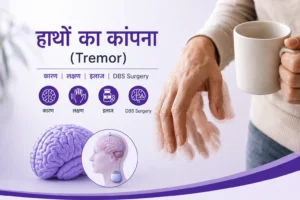
हाथों का कांपना (Tremor): कारण, लक्षण, प्रकार, इलाज और DBS Surgery
Tremor एक न्यूरोलॉजिकल लक्षण है जिसमें हाथ बिना इच्छा के कांपते हैं। इसके 8 प्रकार…
Read Article → WhatsApp