Slipped Disc Treatment in Faridabad
A slipped disc, also called a herniated, prolapsed, or bulging disc, is one of the most common causes of back pain, neck pain, and sciatica, and it affects people of every age group. It happens when the soft inner core of a spinal disc pushes through its tough outer ring and presses on a nearby nerve, triggering pain, numbness, or weakness. Long sitting hours, poor posture, heavy lifting, and age-related wear make this a frequent complaint across Faridabad and Delhi NCR. The slipped disc treatment in Faridabad offered by Dr. Satyakam Baruah covers the full spectrum of care, from physiotherapy and pain management to advanced minimally invasive disc surgery, with a strong preference for treating most patients without an operation.
Early Diagnosis Saves Lives - Book an Appointment Today with Dr Satyakam Baruah!
What Is a Slipped Disc?
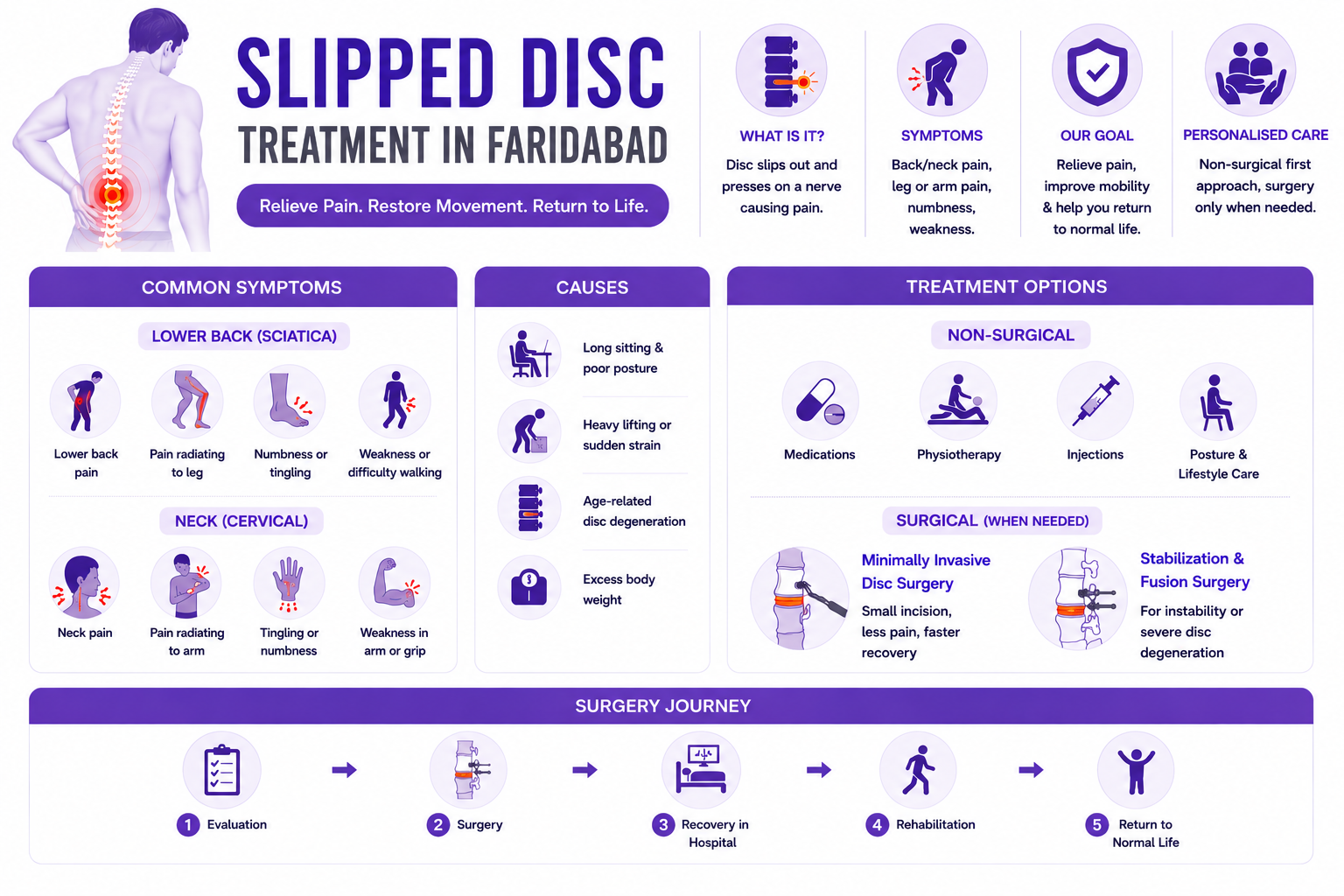
The spine is a stack of bones (vertebrae) cushioned by soft, rubbery pads called intervertebral discs. Each disc has a tough outer ring (annulus) and a gel-like centre (nucleus) that acts as a shock absorber. A slipped disc occurs when the inner gel bulges or leaks out through a weak spot or tear in the outer ring. If this displaced material presses on a spinal nerve or the spinal cord, it causes pain that can radiate into the arm or leg.
A slipped disc can happen anywhere along the spine, but it is most common in the lower back (lumbar spine), where it causes sciatica, and in the neck (cervical spine), where it causes arm pain. Many slipped discs improve with time and conservative care; only a smaller number need surgery.
What Are the Symptoms of a Slipped Disc?
Symptoms depend on where the disc has slipped and whether a nerve is being compressed. Some people have only mild backache, while others have severe radiating pain.
Lumbar (lower back) slipped disc
- Lower back pain that may spread into the buttock, thigh, and leg (sciatica)
- Pain that worsens on sitting, bending, coughing, or sneezing
- Numbness or tingling in the leg or foot
- Weakness in the leg, foot drop, or difficulty walking long distances
Cervical (neck) slipped disc
- Neck pain radiating into the shoulder, arm, or hand
- Tingling or numbness in the fingers
- Weakness in the arm or grip
Red flags (seek urgent care): sudden severe weakness in both legs, numbness around the groin or inner thighs, or loss of bladder or bowel control may signal cauda equina syndrome, a spinal emergency that needs immediate evaluation.
What Causes a Slipped Disc?
A slipped disc usually develops from a combination of gradual wear and a triggering strain rather than a single cause.
- Age-related disc degeneration: Discs lose water content and flexibility with age, making them more likely to tear or bulge.
- Sudden strain or injury: Lifting a heavy object incorrectly, a fall, or a twisting movement can push disc material out.
- Sedentary lifestyle and poor posture: Long hours of desk work, prolonged driving, and slouching place uneven pressure on lumbar discs.
- Repetitive load: Jobs or routines involving frequent bending, lifting, or pulling raise the risk.
- Excess body weight: Extra weight adds continuous stress to the discs of the lower back.
- Other contributors: Smoking (which reduces disc nutrition), weak core muscles, and a family tendency toward early disc degeneration.
When Should You See a Slipped Disc Specialist in Faridabad?
Book a consultation with a slipped disc doctor in Faridabad if you have any of the following:
- Back or neck pain lasting more than a few weeks despite rest and medication
- Pain that shoots down the leg or arm (sciatica or arm radiculopathy)
- Numbness, tingling, or weakness in a limb
- Difficulty walking, standing, or sitting for normal periods
- Pain that disturbs sleep or interferes with daily work
Sudden severe leg weakness, groin numbness, or loss of bladder or bowel control is a medical emergency. Go directly to the emergency department, as these can indicate serious nerve or spinal cord compression.
How Is a Slipped Disc Diagnosed?
Accurate diagnosis confirms which disc is involved, which nerve is affected, and how severe the compression is, all of which guide safe treatment.
- Clinical examination: The doctor checks posture, reflexes, muscle strength, sensation, and performs nerve-tension tests (such as the straight leg raise) to locate the affected level.
- MRI scan: The main and most detailed test. It clearly shows the disc, the degree of herniation, and the nerve or spinal cord being compressed.
- X-rays: Useful to assess spinal alignment, disc-space narrowing, and rule out fractures or instability.
- CT scan: Used in selected cases or for surgical planning when bone detail is needed.
- Nerve conduction study / EMG: Occasionally used to measure nerve function and confirm the level of nerve involvement.
What Are the Treatment Options for a Slipped Disc in Faridabad?
Treatment is decided by the severity of symptoms, the degree of nerve compression, how long symptoms have lasted, and the patient’s overall health. Most slipped discs are managed successfully without surgery.
| Severity / Situation | Typical Treatment Approach |
| Mild pain, no significant nerve symptoms | Activity modification, medication, physiotherapy |
| Moderate pain with sciatica, improving slowly | Structured physiotherapy plus image-guided spinal injection |
| Severe or persistent pain not responding in 6 to 12 weeks | Surgical evaluation, minimally invasive discectomy |
| Progressive weakness, foot drop, or nerve damage | Prompt surgery (microdiscectomy / endoscopic discectomy) |
| Cauda equina signs (bladder/bowel involvement) | Emergency surgery |
Non-surgical (conservative) treatment
Most patients begin here, and most recover with this approach alone:
- Medication: anti-inflammatory drugs, muscle relaxants, and nerve-pain medicines to control symptoms
- Physiotherapy: core-strengthening, posture correction, and stretching to offload the disc and prevent recurrence
- Activity modification: short-term rest from aggravating activities, followed by a gradual return to movement
- Image-guided spinal injections: targeted epidural or nerve-root injections that reduce inflammation around a compressed nerve
- Lifestyle changes: weight management, ergonomic seating, and safe lifting technique
Surgical treatment for Slipped Disc
Surgery is considered only when conservative care has genuinely failed, or when there is significant or progressing nerve damage. The aim is to take pressure off the nerve while preserving spinal stability. When an operation is the right choice, modern minimally invasive spine surgery allows the disc fragment to be removed through a very small incision, meaning less blood loss, less muscle damage, and a faster return to normal life.
Struggling with Seizures, Persistent Headaches, or Other Neurological Symptoms?
When Is Slipped Disc Surgery Needed?
Slipped Disc Surgery is recommended when:
- Severe leg or arm pain persists despite 6 to 12 weeks of proper conservative treatment
- There is progressive muscle weakness, foot drop, or worsening numbness
- Sciatica is disabling and prevents work or normal activity
- Imaging shows a large herniation clearly compressing a nerve, matching the symptoms
- There are emergency signs of cauda equina syndrome (requiring urgent surgery)
Minimally Invasive Slipped Disc Surgery (Microdiscectomy)
Microdiscectomy and endoscopic discectomy are the gold-standard procedures for a herniated disc causing nerve pain. Through a small incision, the surgeon uses a microscope or endoscope and fine instruments to remove only the herniated fragment pressing on the nerve. The rest of the healthy disc is left intact, so the mechanical structure of the spine is preserved.
Compared with traditional open surgery, the minimally invasive approach generally means:
- Smaller incision and minimal muscle disturbance
- Less blood loss and post-operative pain
- Short hospital stay, often discharge within 24 to 48 hours
- Early walking and a quicker return to daily activities
In selected cases where a disc is badly degenerated or the spine is unstable, spine stabilization and fusion surgery may be advised to secure the affected segment. Where needed, neuronavigation is used to plan and perform the procedure with added precision.
Struggling with Back Pain, Sciatica, or Persistent Neurological Symptoms?
- Specialized care for complex spine and neurological conditions
- Evidence-based, advanced treatment techniques
- Hassle-free consultation scheduling
- Support for patients and family at every step
Slipped Disc Treatment Cost in Faridabad
The cost of slipped disc treatment in Faridabad varies widely because every patient’s situation is different. Many patients are managed without surgery at a fraction of surgical cost. As a general guide for patients in Faridabad and Delhi NCR:
| Service | Approximate Cost (INR) |
| Initial consultation with examination | ₹1,000 to ₹2,000 |
| MRI scan (spine) | ₹6,000 to ₹12,000 |
| Physiotherapy | ₹500 to ₹1,500 per session |
| Image-guided spinal injection | ₹15,000 to ₹35,000 |
| Microdiscectomy / endoscopic discectomy | ₹1,40,000 to ₹2,50,000 approx. |
| Disc surgery with stabilization / fusion | ₹2,50,000 to ₹5,00,000+ approx. |
These figures are indicative only. The final cost depends on the type of procedure, implants used (if any), length of hospital stay, imaging, and rehabilitation needs. A precise estimate is given after personal evaluation, with no hidden charges. For a broader breakdown, see the spine surgery cost in Faridabad page.
Why Choose Dr. Satyakam Baruah for Slipped Disc Treatment in Faridabad?
Choosing the right spine specialist is one of the most important decisions for anyone living with back or neck pain. With Dr. Satyakam Baruah, patients get experience, sound judgement, and compassionate care under one roof.
- 20+ years of neurosurgical experience with 5,000+ procedures performed, including complex spine surgery
- MCh in Neurosurgery from NIMHANS, Bangalore, India’s top-ranked neurosciences institute
- Fellowship training at Montreal Neurological Institute, McGill University, Canada
- Conservative care first, surgery is recommended only when truly required
- Advanced operation theatres with intraoperative neuromonitoring, neuronavigation, and modern minimally invasive instrumentation
- Multidisciplinary team at Amrita Hospital, Faridabad
- Easy access from Faridabad, Delhi, Gurgaon, Noida, Greater Noida, Ghaziabad, and Palwal
Slipped Disc Treatment for International Patients
India is a trusted destination for advanced spine care, combining international-standard technology with cost-effective treatment. International patients under Dr. Baruah’s care receive end-to-end support, including:
- Pre-travel case review and cost estimation
- Visa and travel documentation support
- Airport pickup, accommodation, and interpreter assistance
- Continuous tele-consultation follow-ups after discharge
Book Your Slipped Disc Consultation in Faridabad
If you are dealing with persistent back pain, neck pain, or sciatica that radiates into a limb, do not wait for it to worsen. An early evaluation keeps more treatment options open, and most patients recover well without surgery when seen in time.
Schedule a consultation with Dr. Satyakam Baruah for an expert slipped disc assessment and a personalised treatment plan in Faridabad. Book online or call +91-9650708834.
Frequently Asked Questions
1. Can a slipped disc heal without surgery?
Yes. Most slipped discs improve with conservative treatment such as medication, physiotherapy, activity modification, and sometimes spinal injections. The body often reabsorbs herniated disc material over weeks to months. Surgery is needed only in a minority of cases with severe pain or nerve damage.
2. How long does a slipped disc take to recover?
Many patients feel significant relief within 6 to 12 weeks of conservative care. If surgery is needed, microdiscectomy patients often walk within a day, are discharged within 24 to 48 hours, and return to light activity in a few weeks, with fuller recovery over 6 to 12 weeks.
3. Is slipped disc surgery safe?
Modern minimally invasive disc surgery is very safe in experienced hands. With small incisions, magnification, and nerve monitoring, risks are low and most patients get excellent, lasting relief from leg or arm pain.
4. What is the difference between a bulging disc and a herniated disc?
A bulging disc sags outward but its outer ring is still intact. A herniated disc has an actual tear through which the inner gel leaks out. A herniated disc is more likely to press on a nerve and cause radiating pain.
5. Can a slipped disc come back after treatment?
Yes, re-herniation is possible, but it is uncommon. Core-strengthening physiotherapy, good posture, safe lifting technique, and weight management greatly reduce the chance of recurrence.
6. Will I need an MRI for a slipped disc?
In most cases, yes. An MRI is the most accurate test to confirm a slipped disc, identify the exact level, and show which nerve is compressed, which is essential for planning the right treatment.
7. Is bed rest good for a slipped disc?
Only short-term rest helps during the worst of the pain. Prolonged bed rest actually weakens the back. Gentle, gradual movement and guided physiotherapy speed up recovery.
8. When is a slipped disc an emergency?
Sudden weakness in both legs, numbness around the groin, or loss of bladder or bowel control are emergency signs of cauda equina syndrome and need immediate hospital evaluation and usually urgent surgery.
9. Where is slipped disc treatment in Faridabad available?
Dr. Satyakam Baruah offers comprehensive slipped disc treatment at Amrita Hospital, Sector 88, Faridabad, Haryana, easily reachable from across Delhi NCR including Gurgaon, Noida, Greater Noida, Ghaziabad, and Palwal.

Dr. Satyakam Baruah’s Medical Content Team
Dr. Satyakam Baruah’s medical content team specialises in creating accurate, clear, and patient-focused healthcare content. With strong clinical understanding and expertise in technical writing and SEO, the team translates complex medical information into reliable, accessible resources that support informed decisions and uphold Dr. Satyakam's commitment to quality care.
This content is reviewed by Dr. Satyakam Baruah
 WhatsApp